Shipment Shortages During Transportation: How Can Missing Goods Turn Into Lost Profits?#
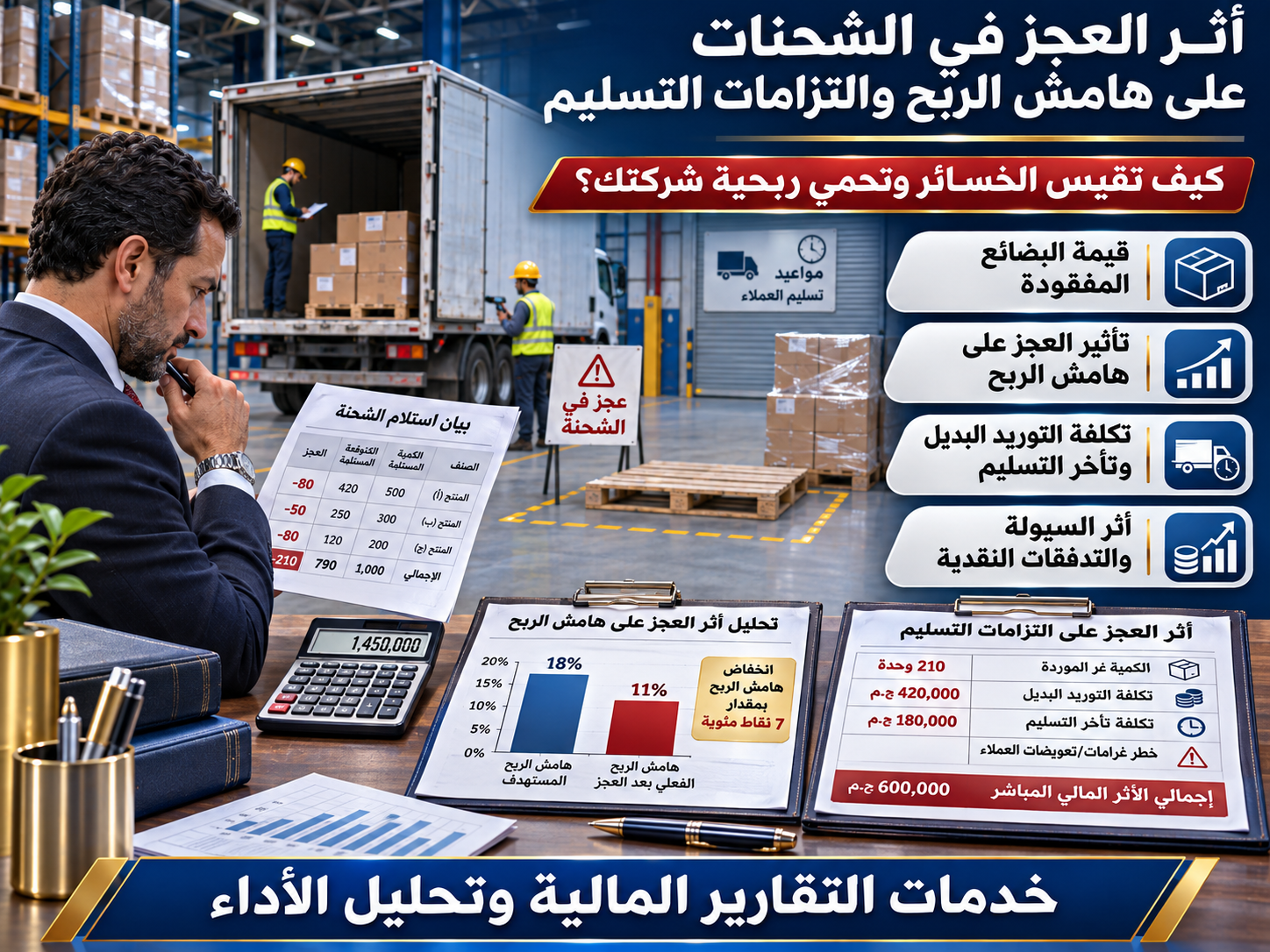
Consider a distribution company that contracts with a transportation provider to deliver products from its central warehouse to a customer in another Egyptian governorate.
The shipment is scheduled to arrive by a specific contractual deadline.
Upon delivery, the company discovers that some goods are missing, although the transportation documents indicate that the full quantity was loaded.
Initially, the financial damage may appear limited to the purchase cost of the missing products.
However, if the shipment relates to a confirmed customer order, the shortage may prevent the company from fulfilling its delivery obligations.
The business may need to purchase replacement goods at higher prices, arrange emergency transportation, or negotiate revised delivery terms.
Delays may also lead to lost sales, customer discounts, or contractual penalties where the conditions for such penalties are satisfied.
Meanwhile, the carrier may deny liability, leaving the company responsible for financing operational recovery while pursuing compensation.
This creates two interconnected financial challenges: recovering the value of the loss and protecting ongoing commercial operations.
A comprehensive financial assessment should therefore answer two essential questions:
What is the actual economic loss caused by the shipment shortage, and which available option minimizes its impact on profit margins and delivery obligations?
1. What Financial Losses Can Result From Shipment Shortages?#
The financial consequences can be classified into four main categories.
These categories should be assessed separately to prevent double-counting.
Loss of Missing Inventory
Missing goods represent inventory assets whose loss may affect the company's financial position.
The financial impact should be determined using the recorded inventory cost and the applicable accounting policies.
It is essential to distinguish between the purchase cost of the goods and their selling price.
For example, if a product costs EGP 350 and would normally be sold for EGP 500, the value of the missing inventory differs from the revenue expected from its sale.
The selling price alone should therefore not be used to measure the inventory loss.
Lost Contribution Margin
If the shortage causes confirmed sales to be canceled or reduces the quantities delivered, the company may lose the contribution margin that those sales would have generated.
Contribution margin represents sales revenue minus the variable costs associated with generating that revenue.
It is not necessarily identical to the gross profit reported in financial statements, because accounting cost of sales may include expenses that do not vary directly with sales volume.
Additional Operating Expenses
Shipment shortages may force companies to incur expenses that were not included in their original operating plans.
Examples include replacement purchases, express transportation, temporary storage, additional packaging, emergency inventory checks, and rescheduling expenses.
Only additional expenses caused by the shortage should be included in the economic assessment.
Costs that would have arisen regardless of the incident should not be counted again.
Financial Consequences of Delivery Obligations
Failure to deliver the agreed quantity on time may result in customer discounts, potential contractual penalties, settlement expenses, or lost future business opportunities.
However, a financial report must distinguish between penalties already incurred, amounts still subject to negotiation or dispute, and uncertain estimates of future lost sales.
2. How Can Shipment Shortages Affect Profit Margins?#
Measuring the financial impact requires comparing the profitability expected if the entire shipment had arrived with the actual or projected results following the shortage.
Two indicators are particularly useful.
Gross Profit Margin
\[ \text{Gross Profit Margin} = \frac{\text{Net Sales}-\text{Cost of Sales}}{\text{Net Sales}} \times100 \]
Contribution Margin per Unit
\[ \text{Contribution Margin per Unit} = \text{Selling Price}-\text{Variable Cost per Unit} \]
Gross profit margin helps assess sales profitability from a financial reporting perspective.
Contribution margin is often more useful when evaluating whether purchasing replacement goods or incurring additional delivery expenses can prevent lost sales.
Practical Example
Assume a distribution company sends a shipment containing 1,000 product units.
The shipment has the following characteristics:
Description | Amount |
|---|---|
Original shipment quantity | 1,000 units |
Selling price per unit | EGP 500 |
Original cost per unit | EGP 350 |
Missing quantity | 100 units |
Quantity delivered | 900 units |
Assuming the EGP 350 unit cost represents the relevant variable cost, the expected contribution margin from selling all 1,000 units would be EGP 150,000.
If the company cannot replace the missing goods and permanently loses the sale of 100 units, the lost contribution margin is estimated at EGP 15,000.
The missing inventory also represents a loss of EGP 35,000.
Estimated economic loss without replacement
EGP 50,000
Cost of missing inventory
EGP 35,000
Lost contribution margin
EGP 15,000
Hypothetical example assuming permanent loss of sales, no additional costs, and no recoveries. The figure represents the economic impact compared with the original business plan, not a single accounting entry.
The example demonstrates that considering only the cost of missing inventory would overlook part of the economic loss.
However, treating the full value of unrealized revenue as an additional loss would overstate the financial impact by double-counting relevant costs.
3. How Do Shipment Shortages Affect Contractual Delivery Obligations?#
Manufacturers and distribution companies frequently operate under supply agreements or purchase orders specifying quantities and delivery deadlines.
A shipment shortage may prevent the supplier from fulfilling these obligations without taking additional action.
The financial consequences depend on the commercial arrangements.
If the customer agrees to postpone delivery: The financial impact may be limited to additional storage, transportation, or temporary financing costs, provided the sale is ultimately completed.
If the customer requires immediate delivery: The company may need to purchase replacement goods at higher prices and arrange urgent transportation.
If the customer refuses partial delivery: The financial consequences may extend to the entire order, requiring an assessment of cancellation or replacement delivery costs.
If the contract includes delay penalties: The company must determine whether the penalties are actually applicable and assess their value under the relevant contractual terms and legal circumstances.
Therefore, evaluating the financial impact of a shipment shortage requires examining the company's delivery schedule and commercial obligations, not merely calculating the number of missing units.
4. Replacement Shipment or Accepting the Shortage: Which Option Is More Cost-Effective?#
When a shipment shortage occurs, management must decide whether to replace the missing quantity immediately or negotiate a reduction or postponement of the delivery.
The decision should compare the additional cost of each alternative with the financial benefits it can preserve.
Using the previous example, assume the company can purchase 100 replacement units at EGP 390 each instead of the original EGP 350.
Emergency transportation will cost an additional EGP 5,000.
The financial calculations would be:
Financial Component | Amount |
|---|---|
Purchase of 100 replacement units | EGP 39,000 |
Emergency transportation | EGP 5,000 |
Additional cost of replacing the missing shipment | EGP 44,000 |
Estimated economic loss without replacement | EGP 50,000 |
Financial comparison of available options
Without replacement
EGP 50,000
Estimated economic loss
With replacement
EGP 44,000
Additional cost relative to the original plan
Illustrative calculation. The replacement scenario includes the cost of new inventory and emergency delivery because the original inventory has already been lost.
In this example, arranging a replacement shipment may reduce the economic impact by EGP 6,000 while preserving the customer order and meeting the delivery obligation.
However, the result could change if emergency transportation becomes more expensive, replacement goods are delayed, or the customer is no longer willing to accept the order.
The lowest numerical cost should therefore not be the only consideration.
Management should also evaluate execution timing, operational feasibility, and commercial risks.
5. How Do Shipment Shortages Affect Cash Flow and Liquidity?#
A shipment shortage can create immediate financial pressure even when the company can absorb the resulting accounting loss.
For example, the business may already have paid for the original inventory and may then need to finance replacement purchases before collecting payment from its customer.
If the carrier refuses compensation, the company may face a cash flow gap throughout the dispute.
Potential consequences include unplanned cash payments, delayed customer collections, increased short-term borrowing requirements, reduced liquidity for supplier payments, and higher financing costs.
Management should prepare a cash flow forecast covering the expected dates of replacement purchases, customer receipts, and any potential insurance or carrier compensation.
Disputed compensation should not be treated as a guaranteed future cash inflow without reliable supporting evidence.
6. How Can Delayed Deliveries Affect Business Profitability?#
A delayed delivery does not necessarily create the same financial loss as a permanently canceled order.
If the customer accepts a later delivery and the sale is ultimately completed, the business may retain the expected contribution margin.
However, it may incur additional storage, transportation, or financing expenses.
If the customer cancels the order and the company cannot sell the products elsewhere at a comparable margin, the business may experience a genuine loss of contribution margin.
Financial assessments should distinguish between three categories.
Realized Losses: Expenses that have already been incurred, such as emergency freight or replacement procurement costs.
Potential Losses: Amounts that remain uncertain, including contractual penalties still under dispute.
Lost Commercial Opportunities: Possible reductions in future business, such as a customer deciding not to renew a supply agreement.
Uncertain future opportunities should not automatically be treated as confirmed financial losses.
The following performance indicators can help management assess the broader consequences.
Performance Indicator | What It Measures |
|---|---|
Shipment shortage rate | Missing quantity as a percentage of total shipped quantity |
Lost contribution margin | Profit contribution lost due to unrealized sales |
On-time, in-full delivery rate | Ability to meet agreed quantities and deadlines |
Shortage recovery cost | Additional expenses incurred to address missing goods |
Collection delay | Impact of delayed delivery on customer cash receipts |
Monitoring these indicators over time can help companies determine whether shortages represent isolated incidents or recurring operational risks affecting profitability.
7. How Do Inventory Shortages Affect Financial Statements?#
Missing inventory may reduce the recorded value of assets and result in recognized losses under the applicable accounting standards.
Under International Accounting Standard IAS 2, inventory measurement and recognition requirements address inventory costs, write-downs, and losses, subject to the standard's provisions.
A shipment shortage may also affect the timing of revenue recognition.
Under IFRS 15, revenue recognition is based on satisfying performance obligations by transferring promised goods or services to customers in accordance with the standard's requirements.
For Egyptian companies, the actual accounting treatment should follow the applicable Egyptian Accounting Standards, including relevant provisions governing inventory and revenue from customer contracts.
It is essential to distinguish among the economic loss used for management decision-making, the amount recognized in financial statements, and the compensation sought from the carrier.
These amounts are not necessarily identical.
8. What Should a Company Do if the Carrier Refuses Compensation?#
When a carrier refuses to acknowledge a shortage, the company should continue addressing the operational consequences while preparing its compensation claim.
A practical approach involves two parallel processes.
Financial and Operational Management
This process focuses on measuring losses, identifying replacement options, monitoring cash flow, and reducing the risk of losing customers or sales.
It involves preparing a financial report covering missing inventory costs, lost contribution margins, additional expenses, and the consequences of delayed delivery.
Compensation Claim Assessment
This process focuses on documenting the loss and collecting transportation records, delivery reports, warehouse documents, and financial evidence.
These documents can support an evaluation of the amount the company may seek to recover.
However, demonstrating an economic loss does not automatically establish a legal entitlement to full compensation.
The claim remains subject to contractual terms, applicable liability rules, causation, and the legal requirements governing recoverable damages.
Coordination between financial and legal teams can help ensure that the calculations and supporting evidence are consistent.
9. How Can Businesses Choose the Best Financial Response to a Shipment Shortage?#
The available alternatives depend on the value of the goods, market availability, delivery deadlines, and the commercial relationship with the customer.
Three practical alternatives are commonly considered.
Arranging an Emergency Replacement Shipment
This may be appropriate where the replacement cost is lower than the financial loss that can reasonably be avoided, particularly when meeting the delivery deadline is essential.
Negotiating an Extension of the Delivery Deadline
This may reduce emergency purchasing and transportation costs if the customer agrees to postpone delivery without substantial commercial consequences.
Completing a Partial Delivery and Settling the Remaining Quantity
This approach may be suitable where the nature of the products and the supply agreement allow partial delivery and the customer is willing to accept the available quantity.
No single solution is appropriate for every shipment shortage.
The most economically viable option depends on incremental cash flows, the contribution margin that can be preserved, implementation costs, and the risks affecting the customer relationship.
10. How Can a Financial Report Help Measure Losses and Support Better Decisions?#
A specialized financial report converts the shipment shortage into measurable financial information that management can evaluate.
Rather than focusing exclusively on the value of missing products, the report connects the shortage to the company's profitability, customer commitments, and liquidity.
A comprehensive assessment should include:
Identification of missing quantities and their recorded inventory costs.
Calculation of lost contribution margins.
Assessment of replacement procurement and emergency transportation expenses.
Evaluation of costs associated with delivery obligations.
Analysis of cash flow and liquidity consequences.
Financial comparison of available recovery options.
Documentation of assumptions, supporting records, and estimation limitations.
Sensitivity analysis can also demonstrate how the preferred decision may change when replacement prices increase, delivery delays become longer, or expected compensation decreases.
The Role of Financial Reporting and Performance Analysis Services#
When a company experiences a shipment shortage, management needs to understand more than the number or selling value of the missing products.
Financial reporting and performance analysis services can help identify direct losses, assess the impact on profit margins, evaluate the financial consequences of delivery obligations, and measure potential cash flow pressures.
These services may also include comparing replacement procurement, delayed delivery, and inventory reallocation strategies, with a clear assessment of the costs and risks associated with each alternative.
A documented financial report can support management decisions while providing relevant financial information for the legal assessment of a compensation claim.
Conclusion#
The financial consequences of shipment shortages during domestic transportation can extend beyond the value of missing goods to include lost contribution margins, higher operating expenses, disrupted delivery obligations, and cash flow pressures.
Addressing the problem should therefore involve more than pursuing compensation from the carrier.
Businesses need a comprehensive financial assessment that identifies actual losses and evaluates practical alternatives for reducing their impact.
Separating missing inventory costs, lost sales contributions, and additional expenses allows companies to develop more accurate estimates and avoid overstating or overlooking financial consequences.
If your business has experienced a shipment shortage affecting profit margins or delivery commitments, request a comprehensive financial impact assessment covering inventory losses, replacement procurement costs, delayed deliveries, liquidity consequences, and practical recovery options to support informed.