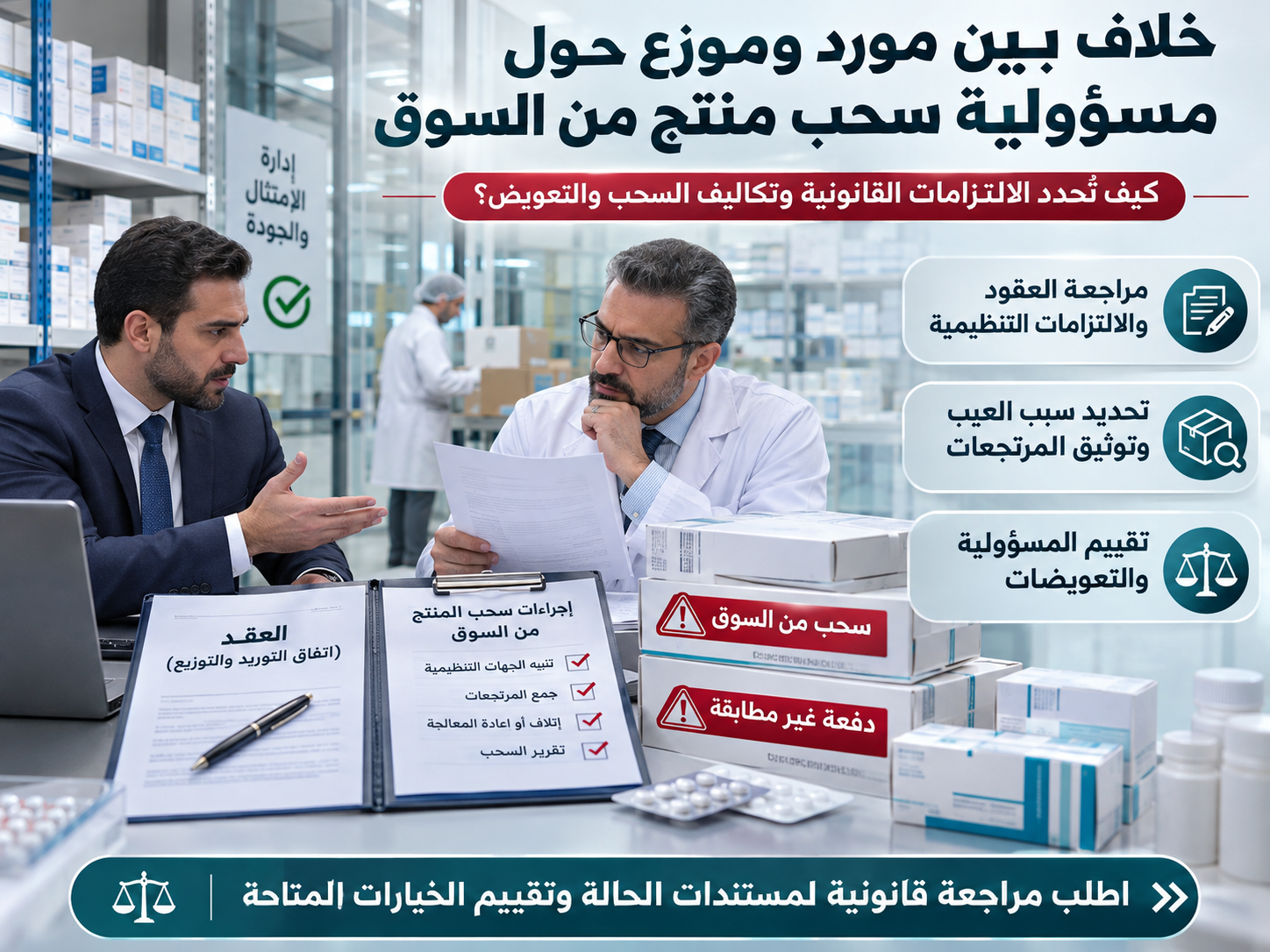
A pharmaceutical distributor receives an official notification requiring the recall of a specific drug batch due to quality defects or non-compliance with approved specifications. Pharmacies and hospitals begin returning the affected products, but the supplier refuses to accept the returned inventory or reimburse the associated expenses.
The supplier argues that improper storage or transportation caused the defect, while the distributor maintains that the products were already defective when delivered.
This situation can create significant legal, financial, and operational challenges for both parties.
Beyond the value of returned products, pharmaceutical recalls may involve transportation costs, additional storage expenses, customer compensation claims, and commercial losses arising from interrupted distribution.
Determining pharmaceutical product recall liability in Egypt therefore requires a careful examination of regulatory requirements, contractual obligations, technical evidence, and the circumstances surrounding the defect.
1. What Is the Legal Framework Governing Pharmaceutical Product Recalls in Egypt?#
Pharmaceutical products in Egypt are subject to regulatory oversight by the Egyptian Drug Authority (EDA), established under Law No. 151 of 2019.
The EDA is responsible for regulating and supervising pharmaceutical products and other medical preparations falling within its jurisdiction.
EDA Chairman's Decision No. 146 of 2022 establishes requirements concerning the recall of non-compliant medical and biological preparations.
Article 4 of the decision requires manufacturers or importers, as applicable, to recall non-compliant products from the market at their own expense, within the applicable regulatory timeframes and under pharmaceutical inspection supervision.
Additionally, the EDA's Regulatory Guideline for Recall and Rapid Alert of Pharmaceutical Products, Fifth Edition (2025), addresses quality defect reporting, recall classification, recall implementation, and effectiveness monitoring.
These requirements establish an important principle: commercial disagreements between suppliers and distributors must not obstruct mandatory pharmaceutical recall procedures.
However, regulatory responsibility for conducting a recall must be distinguished from contractual or civil liability for the resulting financial losses.
The allocation of compensation may depend on the agreement between the parties, the cause of the defect, and whether any party breached its legal or contractual obligations.
2. Who Is Responsible for Recalling a Pharmaceutical Product?#
Responsibility cannot be determined solely by identifying one party as the supplier and another as the distributor.
The legal position depends on each party's actual role, regulatory status, and obligations within the pharmaceutical supply chain.
Responsibilities of Manufacturers and Importers#
Manufacturers and importers are subject to specific regulatory duties concerning pharmaceutical product recalls.
Depending on the applicable requirements, these responsibilities may include:
Coordinating with the Egyptian Drug Authority.
Identifying affected products and batch numbers.
Preparing and implementing recall procedures.
Providing product traceability information.
Monitoring recall progress and effectiveness.
Submitting required regulatory documentation.
Ensuring appropriate handling of recalled products.
Although these regulatory obligations may require manufacturers or importers to bear recall expenses, the final allocation of other losses between commercial parties may require a separate legal assessment.
Responsibilities of Pharmaceutical Distributors#
Distributors also play an essential role in maintaining product safety and facilitating effective recalls.
Their responsibilities may include:
Maintaining accurate records of received and distributed products.
Identifying pharmacies, hospitals, and healthcare facilities supplied with affected batches.
Cooperating with recall instructions.
Segregating products subject to withdrawal.
Maintaining appropriate transportation and storage conditions.
Documenting product returns and related transactions.
Reporting suspected quality defects under applicable regulatory procedures.
A distributor may become liable for particular losses if evidence establishes that its actions or omissions caused or contributed to the defect.
For example, failure to maintain required storage temperatures may damage temperature-sensitive pharmaceutical products.
However, the fact that a defective product was discovered while in a distributor's possession does not automatically establish that the distributor caused the defect.
3. How Does the Cause of the Defect Affect Liability?#
Identifying the source of the quality defect is a central element in determining responsibility.
Different circumstances may produce different legal consequences.
Manufacturing Defects#
If technical investigations establish that the defect originated during manufacturing or existed before delivery, the findings may support a claim against the party legally responsible for the defect.
Depending on the applicable contract and legal requirements, potential claims may involve the value of affected products, recall-related expenses, and documented consequential losses.
Improper Storage or Transportation#
Liability may differ when products were compliant at delivery but subsequently deteriorated because of improper storage or transportation.
In such cases, the investigation should consider:
Temperature monitoring records.
Warehouse operating conditions.
Transportation documentation.
Product handling procedures.
Delivery and acceptance records.
Contractual quality assurance obligations.
These documents can help determine whether a distributor, logistics provider, or another party failed to maintain the required product conditions.
Shared Responsibility#
Some pharmaceutical defects or recall-related losses may result from multiple contributing factors.
For example, an initial product defect may be aggravated by delayed reporting or inadequate handling.
Where more than one party contributed to the loss, liability should be assessed according to the specific conduct involved, the applicable legal rules, and the causal connection between each breach and the resulting damage.
It would be inappropriate to assume that one party must automatically bear every expense without examining the available evidence.
4. Can a Distributor Refuse to Accept Returned Pharmaceutical Products?#
An important distinction must be made between refusing to bear the ultimate financial cost of returned products and refusing to comply with mandatory regulatory recall obligations.
Where a binding recall decision applies, the relevant parties must comply with the procedures applicable to their roles.
A financial dispute should not be used to delay required product withdrawal, segregation, or related safety measures.
However, determining which party ultimately bears the value of returned stock or the associated expenses requires reviewing several questions:
Has the Egyptian Drug Authority issued a recall decision or relevant instructions?
Which products and batches are affected?
What does the distribution or supply agreement provide?
Does the agreement expressly address defective products and returns?
What caused the non-compliance?
Did each party satisfy its notification, storage, and documentation obligations?
In many cases, the practical approach is to implement the required recall procedures while separately documenting and resolving the financial dispute.
This can help protect regulatory compliance without prejudicing the parties' contractual rights.
5. How Do Pharmaceutical Supply Agreements Allocate Recall Responsibilities?#
A pharmaceutical supply or distribution agreement is one of the most important documents for determining the commercial obligations of suppliers and distributors.
Nevertheless, contractual clauses should be interpreted within the broader legal and regulatory framework.
An agreement cannot simply eliminate mandatory regulatory duties.
Several provisions deserve particular attention.
Product Quality Warranties#
These provisions establish the supplier's obligations concerning product quality, specifications, and compliance at delivery.
Inspection and Acceptance Procedures#
These clauses may specify how products must be inspected, accepted, and documented upon delivery.
Defective Products and Returns#
Return provisions may establish procedures for accepting defective inventory, processing returned products, issuing credits, or adjusting payments.
Transportation and Storage Obligations#
The agreement should identify which party is responsible for maintaining appropriate product conditions at each stage of the supply chain.
Quality Defect Notifications#
These clauses establish the parties' duties to communicate suspected defects and coordinate their responses.
Indemnification and Dispute Resolution#
The agreement may address financial responsibility for particular losses, limitations of liability, indemnification arrangements, and mechanisms for resolving disagreements.
The enforceability and interpretation of these provisions must be assessed under applicable Egyptian law and the specific circumstances of the dispute.
6. Who Bears Recall, Storage, Transportation, and Compensation Costs?#
Pharmaceutical recalls may generate substantial direct and indirect expenses.
These can include:
The value of recalled or destroyed products.
Transportation and collection costs.
Warehousing and segregation expenses.
Administrative recall management costs.
Financial claims from affected customers.
Documented commercial losses associated with interrupted distribution.
Under Article 4 of EDA Chairman's Decision No. 146 of 2022, the regulatory obligation to bear recall expenses falls on manufacturers or importers, as applicable.
However, this requirement does not necessarily resolve every financial claim that may arise between parties within the distribution chain.
Claims for additional damages may require proof of a contractual breach or another applicable basis of liability, actual loss, and a causal relationship between the breach and the damage.
It is also important to distinguish documented expenses from estimated losses.
Claims involving lost profits or broader business interruption damages may require detailed financial evidence and legal assessment.
7. What Documents Are Needed to Establish Liability?#
The strength of a pharmaceutical recall dispute often depends on the availability and quality of supporting documentation.
Relevant records may include:
Supply and distribution agreements.
Purchase orders and invoices.
Delivery and acceptance documentation.
Batch numbers and expiry dates.
Certificates of analysis.
Quality control and investigation reports.
Regulatory recall decisions and notifications.
Warehouse and temperature monitoring records.
Transportation and logistics records.
Distribution and customer traceability records.
Returned product inventories.
Correspondence between the supplier and distributor.
Financial records establishing claimed losses.
These materials may help identify when and where the defect occurred, determine whether contractual obligations were breached, and evaluate the financial consequences.
A structured review of technical, commercial, and regulatory evidence is often essential before initiating formal compensation proceedings.
8. What Legal Steps Should Be Taken When a Recall Dispute Arises?#
When a supplier or distributor refuses to accept responsibility for a recall, the affected company should adopt a coordinated regulatory and legal approach.
Step 1: Verify the Recall Requirements#
Review the relevant EDA decision or instructions to identify the affected products, batch numbers, recall scope, deadlines, and required procedures.
Step 2: Secure the Affected Products#
Implement applicable product segregation, withdrawal, and storage procedures while preserving relevant documents and evidence.
Step 3: Review Contractual Obligations#
Examine the supply agreement and associated documentation to determine each party's responsibilities concerning product quality, storage, returns, and financial claims.
Step 4: Prepare a Technical and Legal Evidence File#
Collect technical reports, distribution records, correspondence, and financial documentation.
This information helps establish the circumstances of the defect and the potential liability of the parties involved.
Step 5: Issue a Documented Legal Claim#
Where the evidence establishes a valid basis for a claim, the affected company may issue a formal demand identifying the alleged breach, supporting documents, losses, and requested remedies.
Step 6: Evaluate Negotiation or Formal Dispute Resolution#
A negotiated settlement may provide an effective way to allocate costs and resolve financial claims.
Where negotiations fail, the parties may consider litigation before the competent court or arbitration where a valid arbitration agreement applies.
Commercial dispute resolution should also be distinguished from any separate regulatory procedures for challenging a recall decision.
Each process has its own requirements and legal consequences.
9. How Can Pharmaceutical Companies Reduce Future Recall Disputes?#
Preventing recall disputes requires more than including a standard returns clause in a distribution agreement.
Pharmaceutical companies should establish clear contractual and operational procedures covering quality assurance, defect reporting, recall coordination, product traceability, financial responsibilities, and dispute resolution.
Supply agreements should define the responsibilities of each party at every relevant stage, from product delivery to storage, distribution, and potential withdrawal.
Companies should also maintain documented operating procedures consistent with applicable EDA requirements.
Regular reviews of transportation conditions, storage records, supplier performance, and recall readiness can help identify weaknesses before they result in significant financial or regulatory exposure.
10. The Role of Specialized Legal Advisory in Pharmaceutical Recall Disputes#
Pharmaceutical recall disputes involve a combination of commercial contract law and healthcare regulatory requirements.
Specialized legal advisory can assist manufacturers, distributors, pharmacies, and healthcare companies in understanding their obligations and evaluating their options.
Legal support may include:
Reviewing pharmaceutical supply and distribution agreements.
Assessing regulatory and contractual responsibilities.
Analyzing technical reports and supporting documentation.
Evaluating claims relating to returned products and recall expenses.
Preparing formal legal notices and compensation demands.
Negotiating commercial settlements.
Assessing litigation or arbitration options.
Improving contractual safeguards against future disputes.
An early legal review may be particularly valuable when several parties are involved, substantial amounts are disputed, or the source of the product defect remains uncertain.
Conclusion#
Determining pharmaceutical product recall liability in Egypt requires a careful assessment of regulatory duties, contractual obligations, technical findings, and the conduct of each party.
While mandatory recall procedures must be followed to protect public health, disputes over returned inventory, recall expenses, and compensation require a separate examination of the applicable legal and contractual framework.
Manufacturers, importers, and distributors should therefore preserve relevant evidence, document recall-related expenses, and evaluate their legal positions before making final financial or contractual decisions.
If your company is facing a dispute concerning pharmaceutical product recalls, defective inventory returns, or compensation claims, request a specialized legal review of your agreements and supporting documents to assess your responsibilities, available remedies, and practical options for protecting your commercial interests.