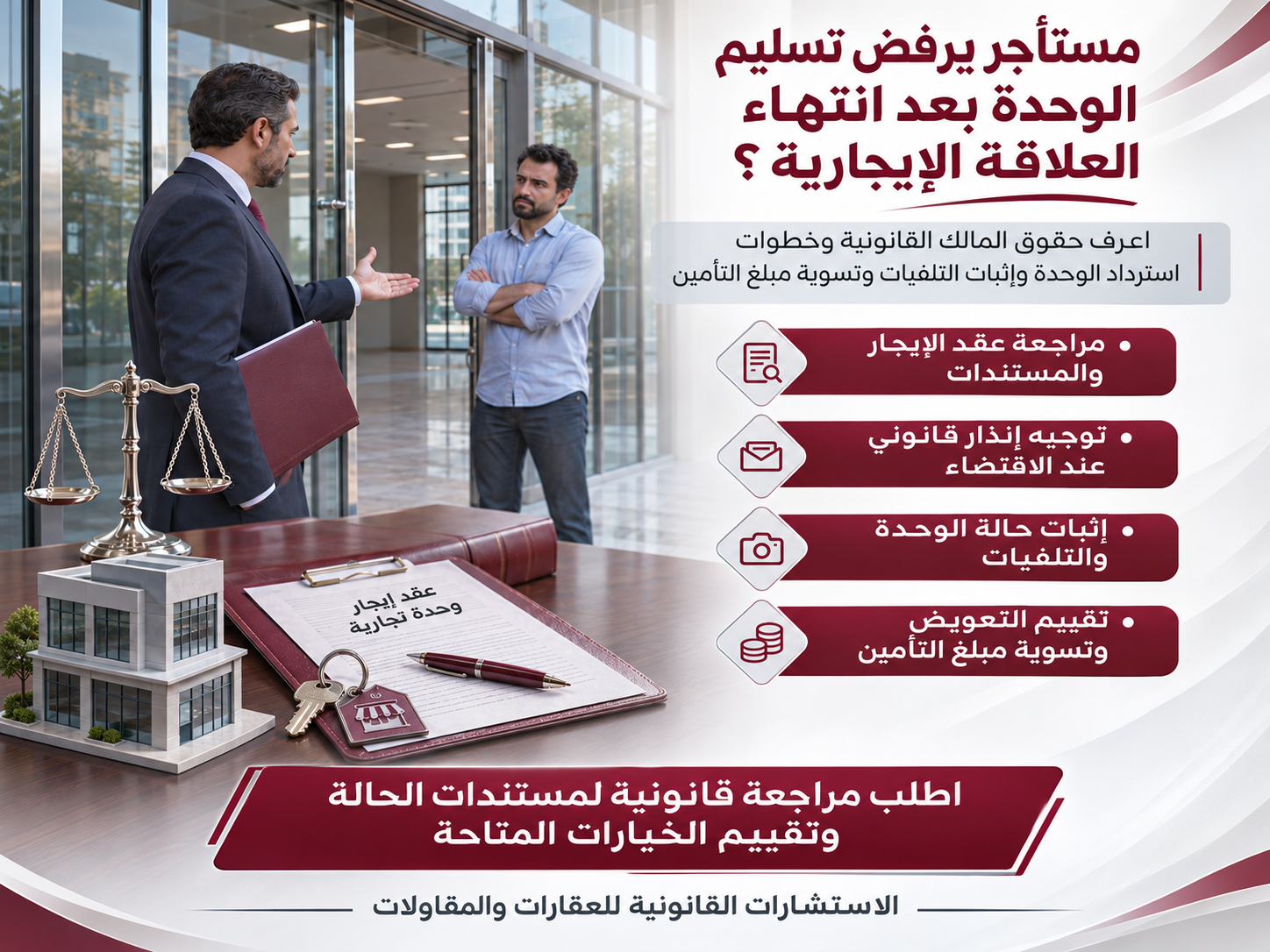
1. Can a Tenant Legally Remain in a Property After the Lease Expires?#
Under the general provisions of the Egyptian Civil Code, a fixed-term lease ordinarily ends upon expiration of its agreed duration without requiring a formal eviction notice, as provided under Article 598.
Article 590 also establishes the tenant's obligation to return the leased property when the lease ends. Where a tenant unlawfully retains possession, the landlord may be entitled to compensation, taking into consideration the property's rental value and the damage suffered.
However, the expiration date stated in a lease agreement does not automatically establish an immediate right to physically remove the tenant in every situation.
Several legal considerations must first be examined, including:
The type of lease agreement and the legal framework governing it.
Whether the agreement includes renewal or extension provisions.
Whether the tenant continued occupying the property with the landlord's knowledge and without objection.
Whether specific contractual notice requirements apply.
Whether the property falls under exceptional rent control legislation.
These distinctions are especially important for commercial and administrative properties, where the applicable legal framework can substantially affect the landlord's options.
2. How Does Egypt's Law No. 164 of 2025 Affect Lease Termination?#
Egyptian rental legislation distinguishes between leases governed by the general provisions of the Civil Code and certain older leases subject to exceptional rental laws.
Law No. 164 of 2025 introduced significant changes to specific categories of existing rental relationships.
For premises leased to natural persons for non-residential purposes and falling within the law's scope, the legislation provides for the termination of covered lease agreements after five years from its effective date, unless the parties agree to terminate earlier.
The law also establishes specific circumstances in which landlords may seek an eviction order from the competent judge for urgent matters, while preserving the possibility of claiming compensation where legally justified.
Nevertheless, these provisions do not automatically apply to every commercial or administrative property.
The tenant's legal status, the date of the agreement, and the legislation governing the contractual relationship must all be examined before determining whether an eviction claim can proceed.
For landlords, identifying the correct legal framework is therefore the essential first step.
3. What Should a Landlord Do When a Tenant Refuses to Vacate?#
When a tenant refuses to surrender possession despite the lawful termination of a lease, the landlord should follow a structured legal process.
Taking premature action may complicate the dispute or create additional liabilities.
Step 1: Review the Lease Agreement and Supporting Documents#
The process begins with a comprehensive examination of the lease agreement and any subsequent amendments.
Key considerations include the contractual term, renewal provisions, property handover conditions, financial obligations, and any communications that may affect the legal status of the tenancy.
This review helps determine whether the lease has legally terminated and what remedies are available.
Step 2: Issue a Formal Legal Notice Where Appropriate#
Depending on the circumstances, the landlord may serve a formal notice requesting that the tenant vacate and surrender the premises.
The notice may identify the legal grounds for termination and reserve the landlord's right to pursue outstanding payments or compensation.
Although certain fixed-term leases expire without requiring notice, formal notification may still serve an important evidentiary purpose.
Articles 599 and 600 of the Egyptian Civil Code address circumstances involving continued occupation after lease expiration and the potential consequences of renewal or objection by the landlord.
Step 3: Initiate the Appropriate Legal Proceedings#
If the tenant continues to refuse possession, the landlord may need to pursue judicial proceedings for eviction, recovery of possession, or property handover.
The appropriate procedure depends on the applicable legislation and the circumstances of the case.
Certain statutory situations may permit a specific expedited legal route.
Importantly, a landlord should not assume that lease expiration authorizes changing locks, removing the tenant's possessions, disconnecting essential services, or using force to recover the premises.
Property recovery must follow the applicable legal procedures.
Step 4: Evaluate Potential Compensation Claims#
A tenant's refusal to vacate may cause financial losses beyond the immediate inconvenience of delayed handover.
Depending on the evidence and applicable law, the landlord may seek compensation related to unauthorized occupation, additional expenses, or other legally recoverable damage.
Such claims should be supported by appropriate documentation and a clear legal basis.
4. What Happens If the Tenant Returns the Property in a Damaged Condition?#
A tenant may agree to vacate the premises, only for a new dispute to arise during the final inspection.
This is particularly common in offices, retail spaces, showrooms, and other commercial premises where significant modifications or installations may have been made.
Damage may involve flooring, walls, electrical systems, air conditioning equipment, plumbing, or permanent fixtures.
Article 591 of the Egyptian Civil Code addresses the tenant's obligation to return the leased property in the condition in which it was received, subject to the applicable exceptions and legal considerations.
The law also contains an evidentiary presumption concerning the condition of the property when it was originally delivered if no written description was prepared.
Nevertheless, not every change in the property's condition necessarily creates a right to compensation.
A distinction must be made between:
Ordinary deterioration resulting from normal use.
Damage attributable to negligence or improper use.
Modifications authorized by the landlord.
Unauthorized alterations.
Defects or maintenance obligations legally attributable to the landlord.
The assessment must consider the lease provisions, available evidence, and the actual cause of the damage.
5. How Can Landlords Prove Property Damage?#
Evidence is often decisive in disputes concerning the condition of leased premises.
A landlord who alleges damage should be prepared to demonstrate the property's original condition, the changes identified upon handover, and the basis for attributing responsibility to the tenant.
Useful supporting documents may include the original handover report, dated photographs, maintenance records, correspondence, inspection reports, and quotations for necessary repairs.
Where a substantial disagreement exists, obtaining a documented inspection or seeking a legally appropriate procedure to establish the property's condition may be advisable.
Expert assessment can be particularly important for commercial properties with valuable electrical installations, telecommunications infrastructure, specialized equipment, or centralized air conditioning systems.
Landlords should also consider documenting damage before undertaking significant repairs, provided that urgent safety or maintenance needs do not require immediate intervention.
Preserving reliable evidence may strengthen subsequent compensation claims and reduce uncertainty during settlement negotiations.
6. Can a Landlord Deduct Repair Costs From the Security Deposit?#
Security deposits frequently become a source of conflict when a lease ends.
Landlords may seek to retain part or all of the deposit to cover outstanding rent, unpaid obligations, or property damage.
Tenants, meanwhile, may demand the full amount, arguing that the premises were returned in an acceptable condition.
Under Egyptian law, the legal treatment of a security deposit depends on the contractual provisions, the nature of the deposit, and the parties' established obligations.
A proper final settlement should examine several issues:
The amount originally paid as a security deposit.
Outstanding rental payments or contractual obligations.
Damage for which the tenant may legally be responsible.
Reasonable and documented repair costs.
Contractual provisions governing deductions and refunds.
A security deposit should not automatically be treated as a penalty that the landlord can retain merely because a disagreement has occurred.
Equally, the tenant's entitlement to a full refund should not be assumed without reviewing legitimate outstanding obligations.
Where possible, the parties should prepare a documented financial settlement showing any justified deductions and the remaining balance.
7. Can Landlords Claim Compensation for Lost Rental Income?#
For commercial real estate investors, delayed possession may affect the property's financial performance.
Consider a landlord who has negotiated a new lease for an office or retail unit, only to discover that the existing tenant refuses to surrender the premises.
The delay may disrupt the new agreement, postpone rental income, and create additional costs.
In some circumstances, the landlord may also incur maintenance expenses, legal costs, or other losses associated with the dispute.
However, the ability to recover compensation depends on the applicable legal rules and the evidence supporting the claim.
It is important to distinguish between actual, legally compensable losses and hypothetical investment returns that cannot be sufficiently established.
Where relevant, the landlord must demonstrate the required connection between the tenant's conduct and the claimed damage.
A legally sound strategy should therefore pursue two objectives: recovering possession through the appropriate procedure and preserving the evidence necessary to establish legitimate financial claims.
8. How Can Commercial Landlords Prevent Similar Disputes?#
The most effective approach to property handover disputes often begins before the lease is signed.
Clearly drafted agreements can reduce uncertainty concerning termination, maintenance, authorized modifications, and the property's condition at the end of the tenancy.
Commercial property owners should consider contractual provisions addressing handover procedures, inspection requirements, security deposit settlement, and the responsibilities associated with alterations or repairs.
A detailed initial condition report, supported by photographs and an inventory of permanent fixtures, may also help prevent future disagreements.
At the end of the lease, a documented handover procedure can record the return of keys, the property's condition, utility meter readings, and any outstanding financial obligations.
For investors managing multiple commercial properties, consistent documentation and professionally reviewed lease agreements can help reduce recurring legal and operational risks.
Conclusion: Recovering Leased Property Requires the Right Legal Strategy#
A tenant's refusal to vacate after lease expiration can develop into a wider legal and financial dispute involving property possession, damage claims, security deposits, and lost rental opportunities.
Under Egyptian law, the available remedies depend on the applicable rental legislation, the contractual terms, and the evidence surrounding the dispute.
Landlords should therefore avoid taking unilateral action before establishing the legal status of the tenancy and identifying the appropriate recovery procedure.
A careful review of the lease agreement, supporting documents, and potential financial claims can help protect the owner's rights and support a more effective resolution.
Is a Tenant Refusing to Vacate Your Commercial or Administrative Property?#
Disputes over lease termination, property handover, damage, and security deposits require careful legal assessment.
Professional real estate legal advisory services can assist property owners and investors in reviewing lease agreements, assessing their legal position, identifying available remedies, and evaluating potential claims for compensation.
Request a legal review of your lease documents and an assessment of the available options through our Real Estate and Construction Legal Advisory Services.