How Can Delayed Customs Clearance Become a Financial Crisis?#
A shipment of imported raw materials or finished products may arrive at the port on schedule, but an error in the commercial invoice, discrepancies in the bill of lading, or missing customs documentation can prevent the goods from being released on time.
While clearance procedures remain incomplete, the company continues to meet its financial obligations, even though the shipment cannot be used for production or delivered to customers.
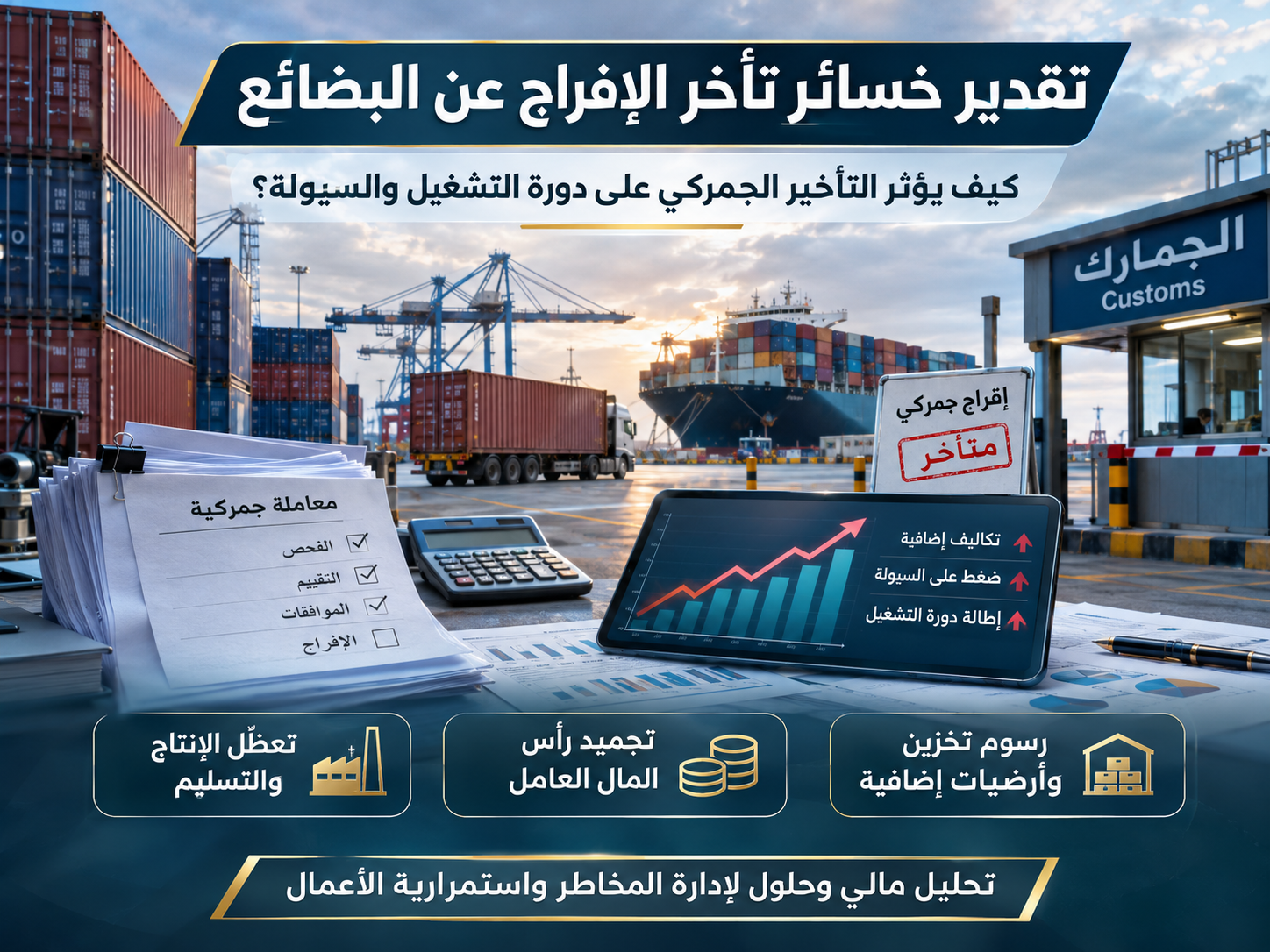
The company may subsequently face additional storage charges, production interruptions, postponed sales, emergency procurement expenses, and increased reliance on short-term financing.
The central financial challenge is that delayed customs clearance is not merely a logistics expense; it can disrupt the entire operating cycle of a business.
For companies that rely heavily on imported raw materials or time-sensitive deliveries, even a relatively short delay can create significant pressure on cash flow and profitability.
Consequently, evaluating the true financial impact requires a comprehensive assessment of direct expenses, operational losses, financing costs, and the potential disruption of future cash inflows.
1. What Financial Losses Can Result from Delayed Cargo Release?#
The financial consequences of customs clearance delays can be divided into three main categories.
Direct Costs of Delayed Clearance
These are the additional expenses incurred because goods remain at the port beyond the expected release period.
They may include:
Additional storage and port charges.
Demurrage and container detention fees.
Documentation correction and resubmission expenses.
Additional handling and inspection charges.
Extra logistics and customs brokerage service fees.
These expenses can usually be identified through invoices, payment records, and statements issued by shipping lines, ports, and service providers.
However, companies should distinguish between normal logistics expenses and incremental costs directly attributable to the delay.
Indirect Operational Losses
Delayed shipments can interrupt activities that generate revenue.
For example, a manufacturing company waiting for imported raw materials may be forced to suspend production, reduce output, or purchase alternative materials at higher prices.
Similarly, a distributor may fail to meet customer delivery schedules, potentially resulting in canceled orders, contractual charges, or reduced customer confidence.
These losses may include lower production efficiency, emergency transportation expenses, increased unit costs, and lost contribution margins.
Importantly, delayed revenue should not automatically be classified as permanently lost revenue. A reliable financial assessment should distinguish between postponed sales and sales that cannot be recovered.
Financing and Working Capital Costs
Imported goods frequently represent substantial investments that have already been paid for or financed through credit arrangements.
When customs clearance is delayed, the capital invested in those goods remains unavailable for productive use.
This may extend the company's cash conversion cycle and increase its need for additional financing.
Businesses may consequently incur higher interest expenses, additional borrowing costs, or opportunity costs associated with capital that could otherwise have supported profitable operations.
2. How Does Delayed Customs Clearance Affect the Operating Cycle?#
The operating cycle measures the period required for a business to convert its investment in inventory into cash collected from customers.
It is commonly calculated as:
Operating Cycle = Days Inventory Outstanding + Days Sales Outstanding
The cash conversion cycle also considers the time available to pay suppliers:
Cash Conversion Cycle = Days Inventory Outstanding + Days Sales Outstanding − Days Payable Outstanding
When customs clearance is delayed, the time between acquiring inventory and converting it into sales may increase.
This can extend the operating cycle, particularly when the business has already paid for the shipment or cannot begin production without the imported materials.
However, the effect depends on the company's inventory strategy and operational structure.
A business maintaining adequate safety stock may absorb certain delays without interrupting sales.
By contrast, a manufacturer operating with minimal inventory reserves may experience immediate production disruptions and postponed customer deliveries.
Therefore, the financial effect should be assessed using actual inventory movements, customer collection patterns, and supplier payment terms rather than assuming that every day of customs delay automatically adds one day to the cash conversion cycle.
3. How Can Businesses Calculate the Financial Losses Caused by Delayed Customs Clearance?#
A structured financial assessment should consider four key components.
Step One: Determine the Actual Delay Period
Identify the reasonably expected cargo release date and compare it with the actual or revised release date.
The analysis should account for contractual free periods, applicable storage arrangements, and any days during which no additional fees are incurred.
Step Two: Calculate Incremental Direct Expenses
Record all additional expenses specifically resulting from the delay.
These may include storage, demurrage, detention, handling, documentation corrections, and additional logistics services.
Normal expenses that would have been incurred regardless of the delay should be excluded.
Step Three: Estimate the Cost of Tied-Up Working Capital
The cost of capital associated with delayed cargo can be estimated using the following formula:
\[ \text{Capital Cost} = \frac{\text{Capital Tied Up} \times \text{Annual Cost of Capital} \times \text{Delay Days}}{365} \]
The calculation should use the company's actual borrowing rate when measuring financing expenses or an appropriate cost of capital when assessing opportunity costs.
Care should be taken to avoid double-counting financing expenses already included elsewhere in the analysis.
Step Four: Assess Operational and Commercial Losses
Evaluate the financial consequences of production interruptions, alternative sourcing, emergency deliveries, and canceled orders.
When estimating lost sales, businesses should calculate the contribution margin that would have been earned, rather than treating the entire sales value as a financial loss.
Any costs avoided because the sale or production activity did not occur should also be considered.
4. Practical Example: Calculating the True Cost of Delayed Cargo Release#
Consider a manufacturing company importing raw materials worth EGP 2 million.
A documentation error causes an additional customs clearance delay of 15 days.
During this period, the business incurs storage charges, container-related expenses, documentation correction costs, and emergency operational expenditures.
The following figures are hypothetical and provided for illustration.
Financial Component | Estimated Amount |
|---|---|
Shipment capital value | EGP 2,000,000 |
Additional delay | 15 days |
Additional storage charges | EGP 30,000 |
Container delay and handling expenses | EGP 20,000 |
Documentation correction expenses | EGP 5,000 |
Additional operational or alternative sourcing costs | EGP 25,000 |
Assumed annual cost of capital | 20% |
The estimated capital cost is:
\[ \frac{2{,}000{,}000 \times 20\% \times 15}{365} \approx 16{,}438 \text{ EGP} \]
Therefore, the total estimated financial impact is:
Total Estimated Additional Financial Loss
EGP 96,438
Direct clearance-related expenses
EGP 55,000
Additional operational costs
EGP 25,000
Estimated capital cost
EGP 16,438
This estimate excludes any additional lost contribution margin from permanently canceled sales or contractual compensation obligations that cannot yet be quantified.
The example demonstrates that storage and container fees represent only part of the total financial exposure.
When operational disruption and working capital costs are considered, the economic consequences may become substantially greater.
5. How Do Customs Clearance Delays Affect Cash Flow and Profitability?#
A company can remain profitable on paper while experiencing serious liquidity pressure because imported goods have not been released.
Delayed cargo can affect financial performance through three primary channels.
Reduced Operating Liquidity
When inventory cannot be sold or used in production, the timing of expected customer payments may be postponed.
Meanwhile, obligations such as wages, supplier payments, rent, and financing installments continue.
This mismatch between outgoing payments and incoming cash can create short-term liquidity shortages.
Lower Profit Margins
Storage charges, emergency procurement, additional transportation expenses, and financing costs can increase the overall cost of operations.
Businesses operating under fixed-price customer contracts may be unable to pass these additional expenses on to buyers.
Consequently, profit margins may decline even when the original sales volume remains unchanged.
Increased Financing Requirements
Businesses may need temporary credit facilities or additional working capital to maintain operations while awaiting cargo release.
These arrangements may create additional financial obligations and increase exposure to borrowing costs.
A comprehensive assessment should distinguish between permanent profitability losses and temporary cash flow delays, as each requires a different management response.
6. Should a Company Wait for Cargo Release or Purchase Replacement Goods?#
When a shipment is delayed, management may need to decide whether to wait for customs clearance or acquire replacement materials.
This decision should be based on the total economic consequences of each alternative.
Alternative | Potential Benefit | Financial Risk |
|---|---|---|
Wait for customs clearance | Avoids additional procurement expenses | Continued charges and operational interruptions |
Purchase from a local supplier | Faster access to required materials | Higher purchase prices and possible specification differences |
Arrange urgent imports | May reduce operational downtime | Higher freight and financing expenses |
Reschedule production or deliveries | May preserve short-term liquidity | Delayed revenue and customer dissatisfaction |
The preferred option is the one that minimizes total expected costs while maintaining acceptable operational performance.
For example, if purchasing replacement materials creates EGP 60,000 in additional expenses but is expected to prevent EGP 100,000 in further operational losses, alternative sourcing may be economically justified.
However, the decision should also consider the probability of the original shipment being released soon, the availability of financing, and whether the original goods can still be used or sold later.
7. How Can Businesses Build an Effective Customs Delay Risk Management System?#
Managing customs clearance risks requires more than responding to individual shipment problems.
Companies should establish preventive controls, early warning indicators, and operational contingency plans.
Pre-Shipment Documentation Verification
Importers should implement procedures to verify commercial invoices, bills of lading, packing lists, and other required documentation before shipping.
For businesses operating in Egypt, the Nafeza platform and Advance Cargo Information (ACI) framework are relevant to the electronic submission and processing of shipment information.
Early documentation review can reduce the risk of avoidable discrepancies and clearance delays.
Risk-Based Shipment Classification
Not all shipments carry the same operational significance.
Businesses should classify shipments according to their financial value, production importance, availability of substitutes, and potential effect on contractual commitments.
Critical raw materials that could interrupt an entire production line require greater monitoring than goods supported by adequate inventory reserves.
Early Warning Indicators
Management should monitor indicators such as:
Average cargo release time.
Daily costs associated with delayed shipments.
Value of inventory awaiting release.
Customer orders exposed to potential disruption.
Projected cash requirements during extended delays.
Available inventory coverage for critical materials.
These indicators help organizations identify emerging problems before they become major financial disruptions.
Business Continuity Planning
A business continuity plan should establish alternative suppliers, emergency procurement procedures, suitable safety stock levels, financing arrangements, and escalation responsibilities.
The plan should be reviewed and tested periodically to ensure that it remains effective as market conditions and operational requirements change.
8. Which Financial Indicators Should Management Monitor?#
Businesses can improve their ability to assess customs clearance risks by integrating financial and operational performance indicators.
Indicator | Management Purpose |
|---|---|
Average Customs Clearance Time | Identifies unusual delays and evaluates clearance efficiency |
Delay Cost per Shipment | Measures the financial impact of individual incidents |
Cash Conversion Cycle | Assesses the time required to recover invested working capital |
Inventory Turnover | Evaluates inventory utilization efficiency |
Operating Profit Margin | Measures the profitability impact of additional costs |
Cash Flow Forecast | Identifies potential financing requirements |
On-Time Delivery Rate | Tracks customer service performance and supply reliability |
These indicators become more valuable when procurement, logistics, warehouse, sales, and finance departments operate through an integrated reporting framework.
9. What Immediate Actions Can Reduce Financial Losses?#
When a customs clearance delay occurs, companies should adopt a coordinated financial and operational response.
The first priority is identifying the cause of the delay and estimating the likely time required to resolve it.
Management should then review the applicable charges, remaining free periods, outstanding documents, and operational consequences.
The finance department should prepare an updated estimate of additional costs and assess the expected impact on cash flow.
At the same time, procurement and operations teams should evaluate alternative sourcing, inventory reallocation, production rescheduling, and possible delivery adjustments.
Businesses should preserve invoices, correspondence, shipment records, and operational reports documenting the circumstances and financial consequences of the delay.
These records may also become important if the parties later dispute contractual responsibility for additional expenses.
The assessment should be updated as new information becomes available, allowing management to make decisions based on current financial exposure rather than outdated assumptions.
10. The Role of Risk Management and Business Continuity System Design#
Companies that regularly depend on international trade need a structured system connecting customs risks, supply chain operations, and financial decision-making.
A professional Risk Management and Business Continuity System Design service can help businesses identify vulnerable operations, evaluate potential disruption scenarios, and establish practical responses.
The scope of such a service may include financial impact assessments, operating cycle analysis, liquidity stress testing, contingency sourcing strategies, early warning indicators, and business continuity procedures.
It can also establish clear responsibilities between finance, procurement, operations, and logistics teams during shipment disruptions.
The objective is not to eliminate every possible customs clearance delay, but to reduce the likelihood of avoidable disruptions, limit their financial consequences, and strengthen the company's capacity to maintain essential operations.
Conclusion: The True Cost of Delayed Customs Clearance Goes Beyond Storage Fees#
Estimating financial losses from delayed customs clearance requires a comprehensive evaluation of direct expenses, operational disruptions, financing costs, and the effects on working capital and cash flow.
A documentation error that initially appears minor can generate substantial financial pressure when it interrupts production, delays customer deliveries, or increases short-term financing requirements.
Through accurate financial analysis, effective performance monitoring, and structured business continuity planning, companies can better anticipate customs-related disruptions and reduce their economic consequences.
If your business frequently experiences financial losses from delayed cargo release, a specialized financial impact assessment and a tailored risk management and business continuity system can help protect liquidity, strengthen operational resilience, and support better commercial decisions.