
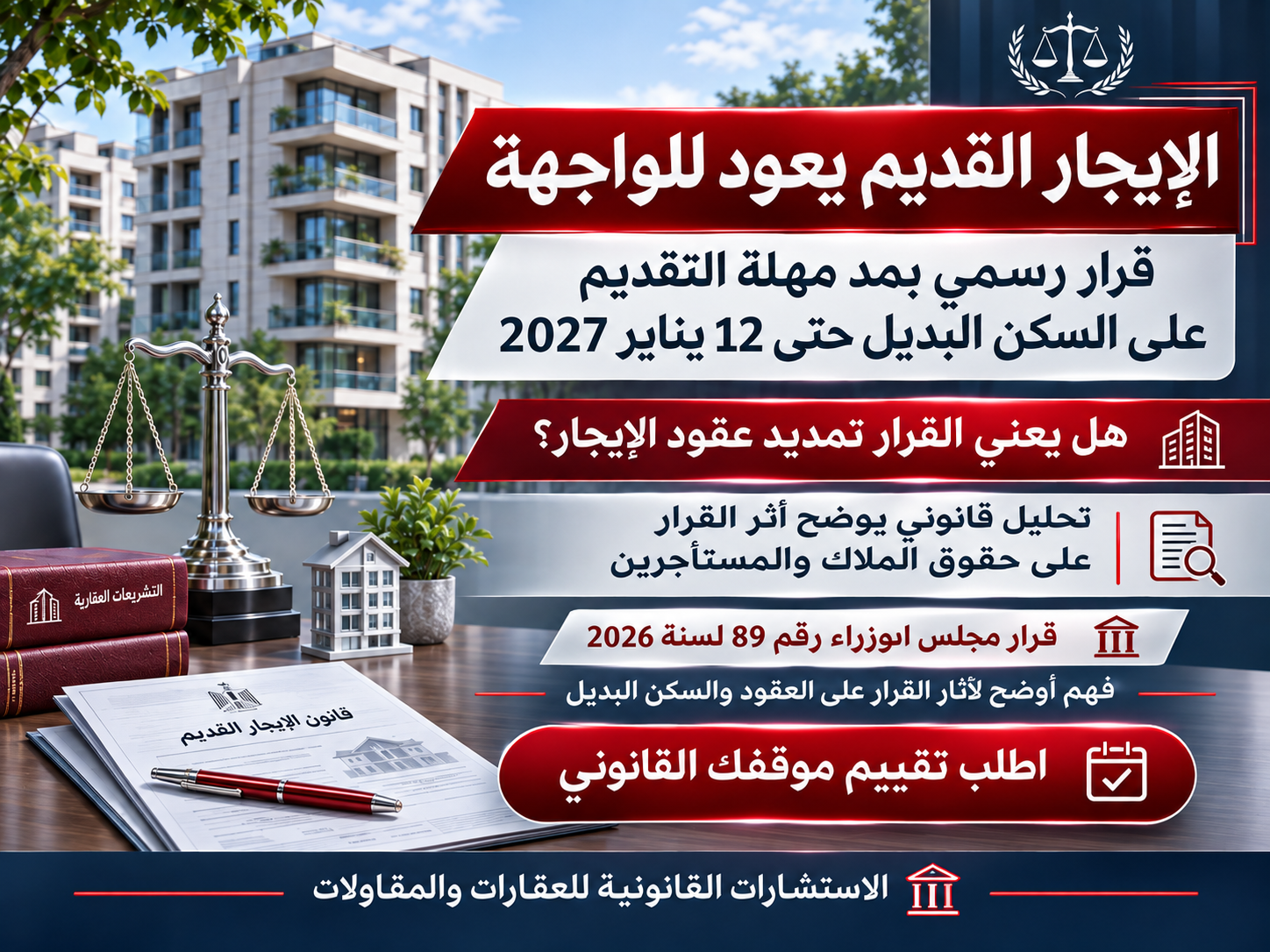
Egypt's Old Rent Law Returns to the Spotlight#
Egypt's old rent system continues to generate significant legal and economic debate, particularly regarding the rights of landlords, tenant protections, and the future of residential and commercial properties governed by longstanding rental arrangements.
In a recent regulatory development, the Egyptian Official Gazette published Cabinet Decision No. 89 of 2026 on November 12, 2026.
The decision extends the period for receiving applications for alternative housing units made available by the state until January 12, 2027.
Issued on November 1, 2026, the decision follows the legislative framework established under Law No. 164 of 2025, which introduced substantial changes to the legal relationship between landlords and tenants under the old rent system.
While the extension provides eligible tenants with additional time to submit their applications, it also creates an important distinction between administrative housing procedures and the statutory duration of existing rental contracts.
Understanding this distinction is essential for landlords, tenants, and real estate investors seeking to assess their legal rights and obligations.
Does the New Decision Extend Existing Old Rent Contracts?#
One of the most important questions arising from the decision concerns whether extending the alternative housing application deadline also extends the duration of rental agreements governed by the old rent legislation.
The answer lies in distinguishing between two separate legal matters.
Cabinet Decision No. 89 of 2026 addresses the administrative period during which eligible tenants may submit applications for state-provided alternative housing.
It does not expressly amend the statutory periods governing the termination of lease agreements under Law No. 164 of 2025.
Article 2 of the law provides that residential lease agreements subject to its provisions terminate seven years after the law enters into force.
For premises leased to natural persons for non-residential purposes, the law establishes a five-year termination period, unless the parties agree to terminate the lease earlier.
Consequently, extending the alternative housing application deadline should not automatically be interpreted as extending existing leases or changing the statutory termination framework.
This distinction is particularly important when evaluating property recovery plans, contractual obligations, and potential disputes between landlords and tenants.
What Does the Extension Mean for Tenants?#
For eligible tenants, the decision creates an additional opportunity to complete the application process for alternative housing units.
Article 8 of Law No. 164 of 2025 establishes a framework under which eligible tenants, or persons to whom lease rights have lawfully extended, may apply for residential or non-residential units made available by the state.
Depending on the applicable conditions and available arrangements, these units may be allocated through rental or ownership schemes.
However, submitting an application does not automatically guarantee the immediate allocation of a replacement property.
Eligibility assessments, application requirements, allocation priorities, and unit availability remain relevant to the process.
The legislation also establishes obligations concerning the surrender of the existing rented premises when the alternative unit is allocated and received, subject to the applicable legal requirements.
Therefore, tenants should carefully review their eligibility and ensure that applications are submitted within the revised deadline.
How Does the Decision Affect Landlords' Rights?#
The extension may also raise concerns among landlords planning to recover possession of properties currently occupied under old rent agreements.
Some property owners may assume that the additional application period automatically postpones the statutory dates for terminating existing leases.
However, the published decision does not establish such an extension.
The legal framework governing the termination of rental agreements remains subject to the relevant legislation, while the new decision specifically concerns the submission period for alternative housing applications.
Nevertheless, the decision may have indirect practical implications.
For example, landlords and tenants may consider voluntary settlement arrangements, negotiated property handovers, or other mutually acceptable solutions while alternative housing applications are being processed.
In these situations, reviewing contractual rights and statutory obligations is particularly important before initiating eviction proceedings or entering into new agreements.
Could the Decision Influence Egypt's Real Estate Market?#
From a commercial perspective, extending the alternative housing application period may affect how certain property owners and tenants plan their future real estate arrangements.
Additional time to apply for replacement housing could help eligible tenants evaluate their housing options and prepare for potential relocation.
For landlords, developments in the implementation of the old rent legislation may influence decisions concerning property redevelopment, future leasing strategies, and asset utilization.
However, the overall market impact cannot be determined without reliable data on accepted applications, available replacement units, allocation schedules, and actual property handovers.
For real estate investors, the distinction between statutory lease termination provisions and administrative housing measures is particularly significant.
Properties occupied under old rent arrangements may present investment opportunities, but their valuation and potential commercial use require careful consideration of existing lease agreements, legal restrictions, and implementation uncertainties.
What Should Tenants Do Before January 12, 2027?#
Eligible tenants seeking alternative housing should review the official application requirements and ensure that their documentation is complete.
Relevant information may include personal identification details, existing tenancy documentation, household information, and supporting evidence required by the competent authorities.
Applications may be submitted through officially designated channels, including the Egypt Digital Platform, subject to the applicable procedures.
Tenants should also verify whether their circumstances meet the eligibility requirements established by the legislation and implementing decisions.
Importantly, the extension should be treated as additional time to complete the application process, rather than as confirmation of entitlement to a specific property.
What Should Landlords and Property Investors Review?#
For landlords, the decision provides an opportunity to assess the legal status of properties affected by the old rent framework.
A legal review may help clarify whether existing agreements fall within the scope of Law No. 164 of 2025, identify the applicable statutory periods, and determine the rights and obligations of the parties.
Property owners should also consider the implications of negotiated settlements, lawful recovery procedures, and future property utilization plans.
For investors acquiring or managing older real estate assets, understanding the legal position of existing tenants remains a fundamental part of assessing investment risks.
The financial attractiveness of a property may depend not only on its location and physical condition but also on the legal arrangements governing possession, rental income, and future use.
Why Legal Consultancy Matters Under Egypt's Changing Rental Framework#
The implementation of Egypt's old rent legislation creates legal questions for both landlords and tenants.
These questions may concern lease classification, statutory termination periods, alternative housing eligibility, contractual obligations, possession procedures, and potential settlement arrangements.
Specialized Real Estate and Construction Legal Consultancy can help property owners, tenants, and investors assess their legal positions and evaluate available options.
Legal professionals may assist with reviewing existing lease agreements, identifying compliance requirements, and developing appropriate approaches to potential disputes.
They can also support commercial negotiations and property-related legal planning, helping clients make informed decisions while reducing avoidable legal uncertainty.
Conclusion: An Extended Application Deadline, Not an Automatic Lease Extension#
Cabinet Decision No. 89 of 2026 represents an important administrative development in the implementation of Egypt's old rent legislation.
By extending the alternative housing application deadline until January 12, 2027, the government has provided eligible tenants with additional time to pursue replacement housing opportunities.
However, the decision should not be confused with a legislative amendment extending the statutory duration of existing rental contracts.
For landlords, tenants, and investors, understanding this distinction is essential for protecting legal rights, managing contractual obligations, and planning future property decisions.
Call to Action
Does the new alternative housing deadline affect your existing lease agreement, property ownership rights, or real estate investment plans?
Request a professional legal assessment to understand how Egypt's latest old rent regulations may affect your legal position and the options available to you.
Our Real Estate and Construction Legal Consultancy services can assist with lease reviews, landlord–tenant disputes, property rights, and regulatory compliance.


