
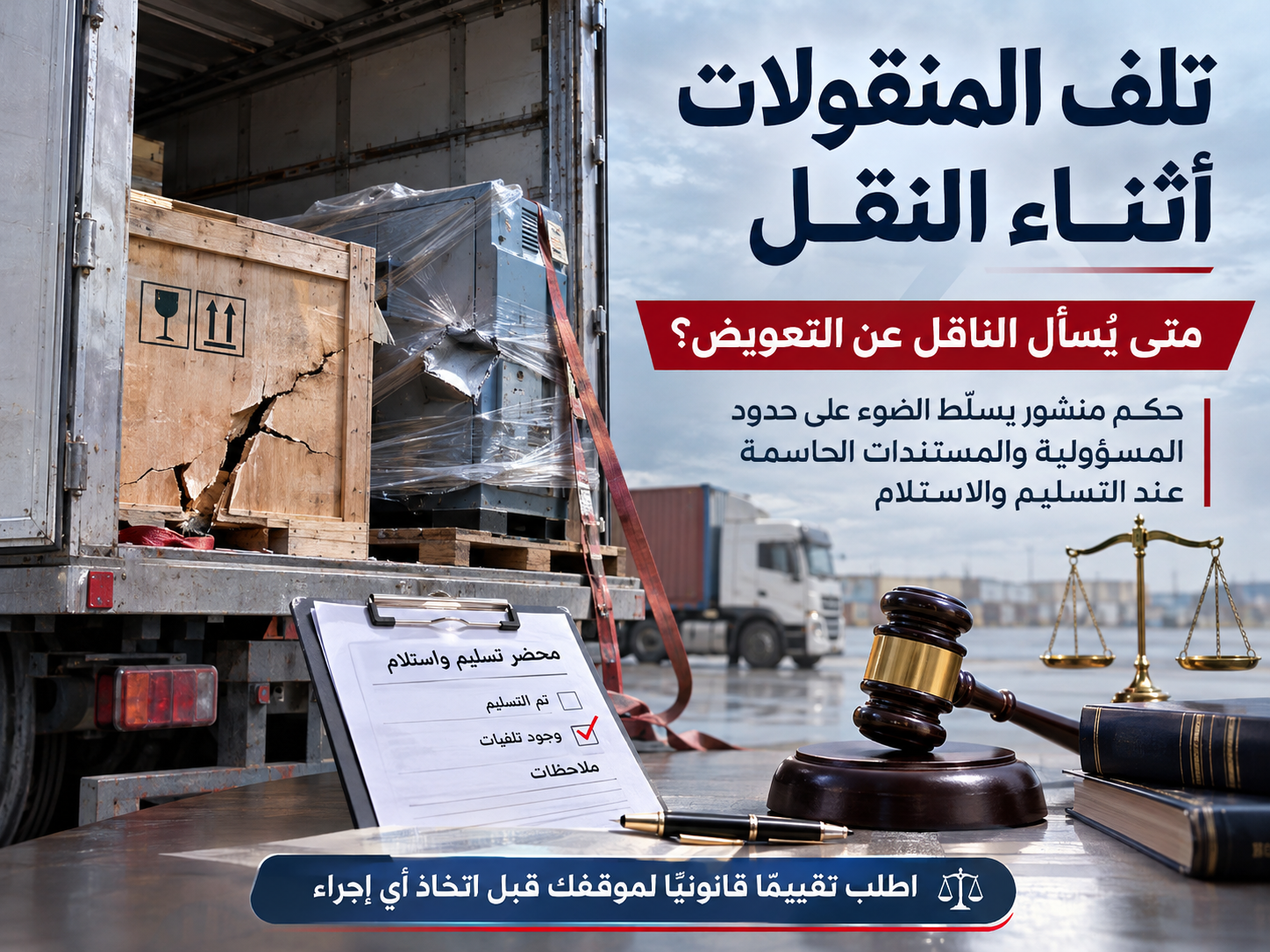
A Lost Container and a Dispute Over Responsibility#
A commercial shipment may pass through several stages before reaching its final destination. Although the cargo owner may have a direct contract with a transportation company, loading, unloading, handling, and storage operations are frequently performed by third-party service providers.
But what happens when cargo is lost or damaged during one of these operations?
Can the carrier argue that another company caused the damage and therefore refuse responsibility?
These questions arose in a dispute examined by the Egyptian Court of Cassation in Appeal No. 6210 of Judicial Year 86, decided on February 9, 2025.
According to the published judgment, the dispute concerned the loss of a shipping container during unloading operations and the legal relationship between the maritime carrier and the contractor responsible for performing those operations.
The case also raised questions about the carrier's ability to seek compensation from the contractor whose actions caused the damage.
Why Was Hiring an Unloading Contractor Not Enough to Eliminate Carrier Liability?#
One of the central issues examined in the judgment was whether appointing a third-party unloading contractor could relieve the maritime carrier of responsibility toward the cargo owner.
According to the published legal text, unloading operations performed by a contractor may, under the circumstances addressed by the judgment, be considered operations carried out on behalf of the maritime carrier and under its responsibility.
An important factor was whether the bill of lading authorized the carrier to select and contract with an unloading company on behalf of the consignee.
In the case under consideration, the published judgment indicated that the bill of lading did not contain such authorization.
This distinction was relevant to the Court's assessment of the contractual relationships and the carrier's responsibility for the contractor's operations.
The case demonstrates that identifying the company that physically caused the loss does not necessarily determine which party the cargo owner may legally pursue for compensation.
What Does This Mean for Importers and Commercial Businesses?#
The judgment provides an opportunity for businesses to reconsider how they structure transportation contracts and manage their commercial logistics relationships.
Many companies work with a principal carrier while additional contractors handle loading, unloading, warehousing, or distribution.
When cargo damage occurs, this arrangement can create uncertainty about the division of responsibilities.
Businesses should therefore examine several questions before signing transportation agreements:
Which party bears responsibility for cargo at each stage of transportation?
When does custody of the shipment transfer between service providers?
Who must be notified when damage or shortages are discovered?
Does the transportation contract regulate liability for subcontractors?
What documents are required to support a compensation claim?
The answers may significantly influence the company's legal position if a dispute arises.
However, the judgment concerns maritime transportation and should not automatically be treated as determining liability in every road transportation dispute. Different modes of transportation may be governed by different legal rules and contractual frameworks.
What Does Egyptian Law Say About Cargo Damage During Commercial Transportation?#
Beyond the specific maritime dispute, Egyptian Commercial Law No. 17 of 1999 contains provisions addressing the obligations and liabilities of carriers transporting goods.
Articles 240 through 254 regulate important aspects of cargo transportation liability, subject to their applicable legal scope.
Under Article 240, the carrier is generally responsible for the total or partial loss of goods, damage, and delays during the period beginning when the carrier receives the goods.
Article 244 addresses circumstances in which a carrier may avoid liability by establishing a legally recognized cause, such as force majeure, an inherent defect in the goods, or an attributable fault of the sender or consignee.
Articles 245 and 246 address contractual provisions concerning exemption from liability and agreements limiting compensation.
These provisions demonstrate the importance of carefully reviewing transportation agreements rather than assuming that all liability clauses are automatically enforceable.
The precise legal position must be assessed according to the type of transportation, the applicable legal framework, and the circumstances of the shipment.
Which Documents Should Businesses Preserve When Cargo Is Delivered or Received?#
One of the most important practical lessons for manufacturers, importers, and distributors is the importance of documenting the condition of transported goods.
A compensation claim may become significantly more difficult when businesses cannot establish when the damage occurred or which party had custody of the goods.
Companies should preserve the following documents:
Transportation Contracts and Bills of Lading: These establish the contractual relationship, transportation terms, and potentially relevant liability provisions.
Commercial Invoices and Cargo Valuation Records: These help establish the value, quantity, weight, and nature of the shipment.
Loading and Unloading Reports: These can help determine when custody transferred and whether damage was observed.
Delivery and Receipt Records: These may establish whether the goods were accepted with or without reservations.
Photographic Evidence: Dated photographs and videos can document cargo condition before transportation and upon arrival.
Inspection and Technical Reports: Independent assessments can help identify the nature, extent, and possible causes of damage.
Written Notifications and Correspondence: Emails, formal notices, and communications with carriers and insurers can help demonstrate when the damage was reported.
Repair and Replacement Estimates: These support the financial assessment of losses and possible compensation claims.
Maintaining organized documentation is particularly important when several contractors participate in transporting and handling the same shipment.
Can Accepting Cargo Without Reservations Affect Compensation Rights?#
Accepting a shipment without recording visible damage or shortages can create legal complications.
Under Article 251 of the Egyptian Commercial Law, acceptance without reservations may affect the consignee's ability to pursue certain claims concerning partial loss or damage, subject to statutory procedures, deadlines, and exceptions.
The applicable rules may differ depending on whether the shipment was transported by road, sea, or air and whether specific international conventions govern the transaction.
Therefore, companies should avoid assuming that the same notification period applies to every transportation arrangement.
Where damage is discovered, promptly documenting the condition of the goods and obtaining legal guidance can help preserve available rights.
How Is Compensation for Damaged Cargo Determined?#
Proving that damage occurred is only one part of a compensation claim.
Businesses must also evaluate the value of the damaged goods, whether the damage can be repaired, and whether the shipment remains suitable for its intended purpose.
Within its applicable scope, Article 247 of Egyptian Commercial Law addresses the basis for determining the value of goods in cases of loss or damage.
Article 249 addresses circumstances involving goods that have become unsuitable for their intended purpose, subject to the statutory conditions.
From a commercial perspective, cargo damage may also cause additional financial consequences, including replacement procurement expenses, interrupted production, delayed customer deliveries, and increased logistics costs.
However, not every financial consequence is necessarily recoverable as legal compensation.
Recoverability depends on the applicable rules, contractual provisions, available evidence, causation, and any relevant limitations of liability.
Companies should therefore distinguish between their total economic exposure and the amounts they may legally claim.
What Should Companies Learn From This Court Ruling?#
The case emphasizes the importance of establishing clear contractual relationships before shipments begin.
Businesses transporting high-value equipment, industrial materials, machinery, or commercial goods should pay particular attention to subcontractor liability, cargo handling procedures, insurance arrangements, and documentation requirements.
A comprehensive transportation agreement should clearly address the parties' responsibilities, the handling of damaged shipments, applicable notification procedures, and available dispute resolution mechanisms.
Such measures cannot eliminate all transportation risks, but they can reduce uncertainty and strengthen the legal position of businesses when disputes arise.
Conclusion: Who Bears the Cost When Cargo Is Damaged?#
The Egyptian Court of Cassation judgment illustrates that responsibility for cargo loss cannot always be determined simply by identifying the party whose actions physically caused the damage.
Contractual arrangements, bills of lading, the carrier's obligations, and the legal relationship with subcontractors may all influence liability.
For importers, manufacturers, and distribution companies, the broader lesson is clear: properly drafted transportation agreements and reliable documentation are essential components of commercial risk management.
Businesses facing cargo damage or transportation disputes should seek a specialized legal assessment of their agreements, shipping documents, and evidence before deciding whether to pursue compensation, negotiate a settlement, or initiate proceedings.


