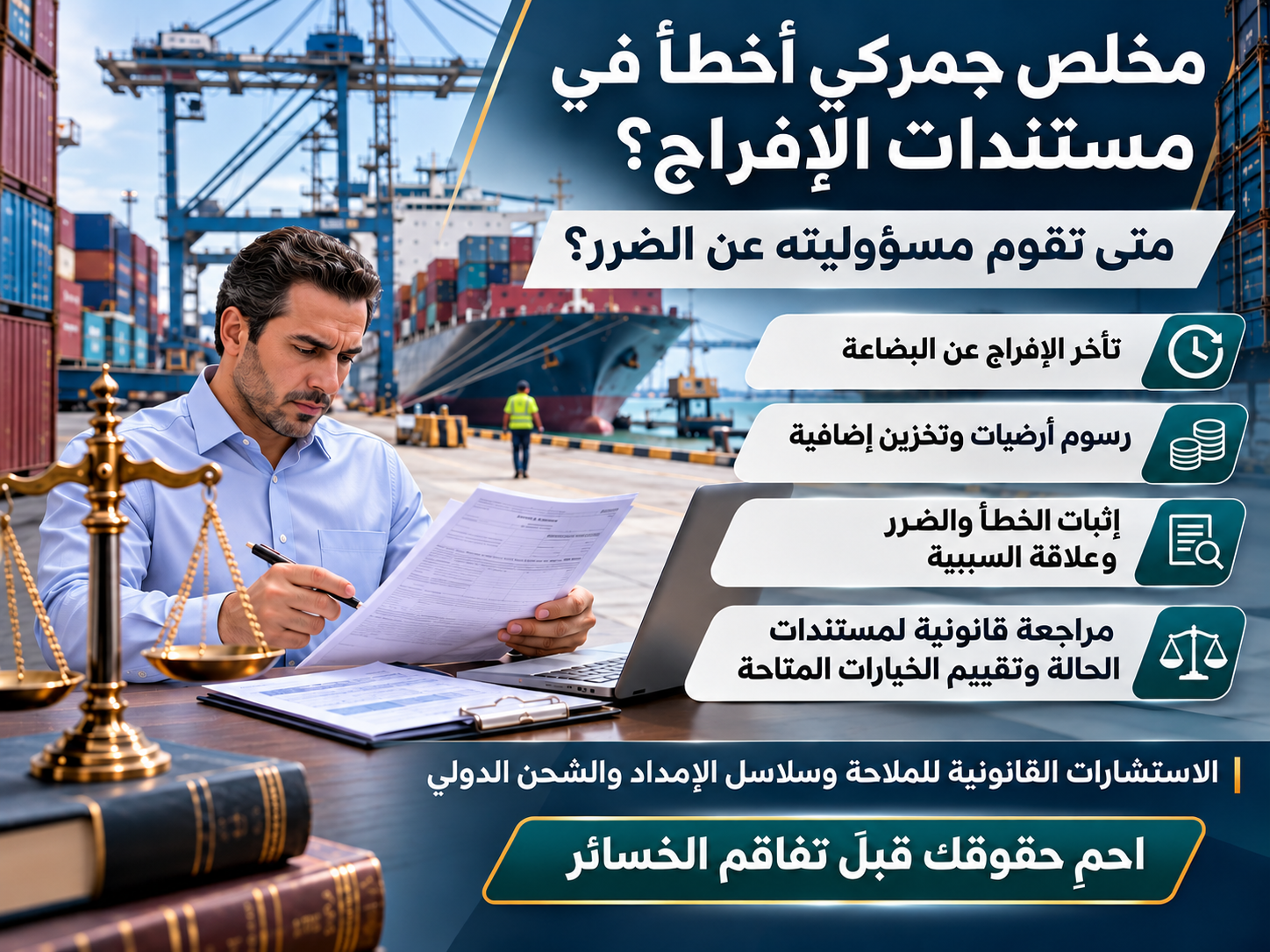
How a Customs Documentation Error Can Disrupt an Entire Shipment#
A shipment arrives at an Egyptian port, and the importer has already arranged transportation, warehouse space, and delivery schedules. The goods are expected to enter production or reach customers within an agreed timeframe.
However, during customs clearance, an inconsistency is discovered between the commercial invoice and the customs declaration. Additional documents or corrections are required before the goods can be released.
As the delay continues, storage charges accumulate, delivery schedules are disrupted, and the importer may face additional financial obligations.
In some cases, the consequences extend beyond port-related expenses. Delayed raw materials may interrupt production, while postponed deliveries may affect contractual commitments and commercial relationships.
This situation raises an important legal question:
If the customs broker was responsible for preparing or submitting the clearance documents, can the importer claim compensation for the resulting losses?
The answer depends on the nature of the broker's obligations, the circumstances surrounding the error, and whether the importer can establish a legally sufficient connection between the broker's conduct and the financial damage.
What Are the Legal and Professional Obligations of a Customs Broker?#
Customs brokers play an important role in international trade by assisting importers and exporters with customs procedures, documentation, declarations, and communication with the relevant authorities.
In Egypt, customs clearance activities are governed primarily by Customs Law No. 207 of 2020 and its Executive Regulations issued under Minister of Finance Decree No. 430 of 2021.
These regulations establish requirements relating to customs procedures, declarations, and the professional activities of customs brokers.
Depending on the contractual arrangement and authorization granted by the client, a customs broker's responsibilities may include reviewing shipment documentation, preparing or submitting customs declarations, monitoring clearance procedures, and notifying the client of missing or inconsistent information.
However, appointing a customs broker does not necessarily mean that the broker guarantees clearance within a particular period.
Cargo release may depend on inspections, regulatory approvals, documentation supplied by the importer, and other procedures outside the broker's control.
Therefore, determining liability requires examining the specific obligations undertaken by the broker rather than assuming responsibility for every delay.
When Does a Customs Broker Become Legally Liable for Documentation Errors?#
Under Egyptian law, determining customs broker liability requires distinguishing between an error occurring during the clearance process and an error for which the broker is legally responsible.
Article 163 of the Egyptian Civil Code establishes the general principle of liability for wrongful conduct that causes damage to another person.
Where a contractual relationship exists between the importer and customs broker, the relevant contractual obligations and rules governing contractual liability must also be considered.
Three essential elements are particularly important.
1. Establishing the Error or Breach
A customs broker may potentially be responsible where the evidence establishes conduct such as submitting incorrect shipment information, improperly modifying documentation, failing to complete an agreed procedure, or neglecting a correction request that falls within the broker's responsibilities.
However, an inconsistency in customs documentation does not automatically establish professional negligence.
The source of the incorrect information must be identified, including whether it originated from the importer, shipping company, supplier, or customs broker.
It is also necessary to determine whether the broker had a contractual or professional duty to identify and correct the problem.
2. Establishing Actual Damage
The party seeking compensation must demonstrate that a financial or commercial loss occurred.
Examples may include additional storage charges, demurrage expenses, unnecessary handling costs, or documented financial losses resulting from delayed delivery.
The existence and amount of these losses should be supported by appropriate financial records and commercial documentation.
3. Establishing Causation
Even where an error and financial loss are established, the claimant must demonstrate a causal connection between the broker's breach and the alleged damage.
For example, if cargo release was delayed because a regulatory authority required an additional inspection, the resulting delay cannot automatically be attributed to the customs broker.
Similarly, where several parties contributed to the delay, the role of each party must be examined before determining responsibility.
Can a Customs Broker Be Required to Pay Storage and Demurrage Charges?#
Storage and demurrage charges are among the most common financial consequences of delayed customs clearance.
However, their existence does not automatically entitle an importer to recover them from a customs broker.
Compensation may be available where the importer demonstrates that the charges resulted from an error or breach attributable to the broker.
Consider a situation where an importer provides complete and accurate documentation within the agreed timeframe, but the customs broker unjustifiably delays submitting the required declaration.
If that delay directly results in additional storage expenses, the importer may have grounds to pursue compensation, subject to the applicable legal requirements.
The situation differs where the broker requested a mandatory document from the importer, but the importer failed to provide it on time.
In that case, determining responsibility would require reviewing communications, contractual obligations, and the actual reasons for the delay.
It is also important to distinguish between ordinary clearance expenses and additional costs specifically caused by the alleged breach.
A successful compensation claim generally requires more than presenting the total amount paid during the clearance process.
Can Importers Claim Compensation for Lost Profits and Delayed Deliveries?#
Customs documentation errors may have consequences extending beyond immediate port expenses.
Delayed cargo release can interfere with supply agreements, interrupt manufacturing operations, affect distribution schedules, or cause businesses to lose commercial opportunities.
Under Article 221 of the Egyptian Civil Code, compensation may include actual losses and lost profits, provided the relevant legal requirements are satisfied.
In contractual liability cases, the recoverability of certain damages may also depend on whether the loss was foreseeable when the obligation was established, subject to the applicable legal exceptions.
Consequently, an importer may potentially seek compensation for commercial losses connected to a customs broker's breach.
However, lost profits cannot simply be assumed.
Supporting evidence may include supply agreements, confirmed purchase orders, delivery deadlines, customer correspondence, financial statements, and documentation establishing the effect of delayed cargo release on business operations.
The purpose of the legal assessment is to determine whether the losses are sufficiently established, legally recoverable, and causally connected to the broker's conduct.
What Documents Are Needed to Prove Customs Broker Liability?#
Documentation is often central to resolving customs clearance disputes.
The strongest claims generally depend on establishing a clear timeline showing when the broker received the documents, what actions were taken, when the error occurred, and how it affected the release process.
Important documents include:
Customs Clearance Agreement: Establishes the broker's contractual responsibilities and the agreed scope of services.
Power of Attorney or Customs Authorization: Identifies the authority granted to the broker.
Commercial Invoice, Bill of Lading, Packing List, and Certificates of Origin: Help verify the original shipment information.
Customs Declarations and Amendment Records: Identify the submitted information and any subsequent corrections.
Emails and Written Communications: Establish when documents were exchanged and whether the broker notified the client of any problems.
Customs and Regulatory Notices: Help identify the reasons for delayed clearance.
Storage, Demurrage, and Handling Invoices: Demonstrate additional expenses.
Supply Contracts and Financial Records: Support claims involving delayed deliveries and other commercial losses.
Electronic records may be particularly valuable when disagreements concern the timing of document submissions, correction requests, or communications between the parties.
Maintaining an organized documentary record can significantly improve the accuracy of a legal assessment.
What Should an Importer Do After Discovering a Customs Clearance Error?#
When an error is discovered, prompt action may help prevent additional expenses and preserve evidence.
The first step is to identify the discrepancy by comparing the original shipment documentation with the customs declaration and any information submitted to the relevant authorities.
The importer should then request a written explanation from the customs broker, identifying the reason for the error and the corrective measures required.
At the same time, the parties should determine whether the declaration can be corrected or additional documents submitted under the applicable customs procedures.
All communications, notifications, and document submissions should be properly recorded.
Once the immediate clearance problem has been addressed, the importer should prepare a detailed statement of additional expenses and examine whether they resulted directly from the broker's conduct.
Before initiating a formal compensation claim, the customs clearance agreement and relevant supporting evidence should be reviewed by a legal professional.
Taking reasonable steps to minimize additional losses is also important, particularly where corrective procedures remain available.
Is the Customs Broker Responsible if the Importer Supplied Incorrect Documents?#
One of the most common disputes arises when the customs broker argues that incorrect information was originally provided by the importer.
For example, the importer may submit an invoice containing inaccurate product descriptions, quantities, or shipment details.
The broker may subsequently rely on that information when preparing the customs declaration.
In such circumstances, liability cannot be determined solely by identifying who submitted the final declaration.
The legal assessment should consider whether the broker was required to review the information, whether the inconsistency was reasonably detectable, and whether the broker informed the client of any apparent problems.
If the broker acted within the agreed scope of services and reasonably relied on information supplied by the importer, this may affect the assessment of responsibility.
Conversely, if the broker was specifically responsible for reviewing the documents and failed to identify an obvious inconsistency, that failure may be relevant.
Where both parties contributed to the damage, the applicable legal rules concerning contributory fault and allocation of responsibility may become important.
Negotiation or Litigation: How Should Customs Clearance Disputes Be Resolved?#
Not every customs clearance dispute requires immediate court proceedings.
Where the documentation is clear and the parties maintain an ongoing commercial relationship, negotiation may offer a practical means of resolving disagreements.
An amicable settlement may address additional expenses, compensation arrangements, or the implementation of procedures designed to prevent similar errors.
However, settlement should be based on a realistic assessment of the parties' contractual obligations, available evidence, and financial exposure.
Where negotiations fail, or substantial losses are disputed, formal legal proceedings may become necessary.
Before taking action, the claimant should examine any contractual provisions relating to jurisdiction, arbitration, liability limitations, and dispute resolution procedures.
A comprehensive assessment should also determine whether another party, such as a freight forwarder, carrier, or supplier, may bear responsibility for part of the loss.
How Can Specialized Legal Consultancy Help Resolve Customs Clearance Disputes?#
Customs clearance disputes often involve several interconnected legal, commercial, and operational issues.
Establishing liability requires an understanding of customs procedures, international shipping documentation, contractual obligations, and the commercial consequences of delayed cargo release.
Specialized legal consultancy in maritime transport, supply chains, and international shipping can assist businesses in reviewing customs brokerage agreements, assessing clearance documentation, identifying potential breaches, and evaluating financial claims.
Legal professionals may also help determine which parties should be involved in negotiations, prepare compensation demands, and assess the viability of litigation or alternative dispute resolution.
Beyond resolving an existing dispute, legal review can help companies strengthen their contractual arrangements and documentation procedures for future shipments.
Clearly defined responsibilities, proper document verification processes, and effective communication protocols may reduce the risk of recurring clearance problems.
Conclusion: Establishing Liability Requires More Than Proving a Delay#
Errors in customs clearance documentation can create substantial financial and operational consequences for importers and exporters.
However, a delayed shipment or unexpected expense does not automatically establish customs broker liability.
A legally sustainable claim requires an assessment of the broker's obligations, the alleged error or breach, the resulting damage, and the causal relationship between them.
Preserving shipment records, documenting additional expenses, and reviewing contractual responsibilities are essential steps toward determining the available legal options.
If your company has experienced delayed cargo release due to a suspected customs documentation error, request a specialized legal review of your shipment records and clearance agreement to assess potential liability, evaluate recoverable losses, and identify the most appropriate legal options for protecting your commercial interests.