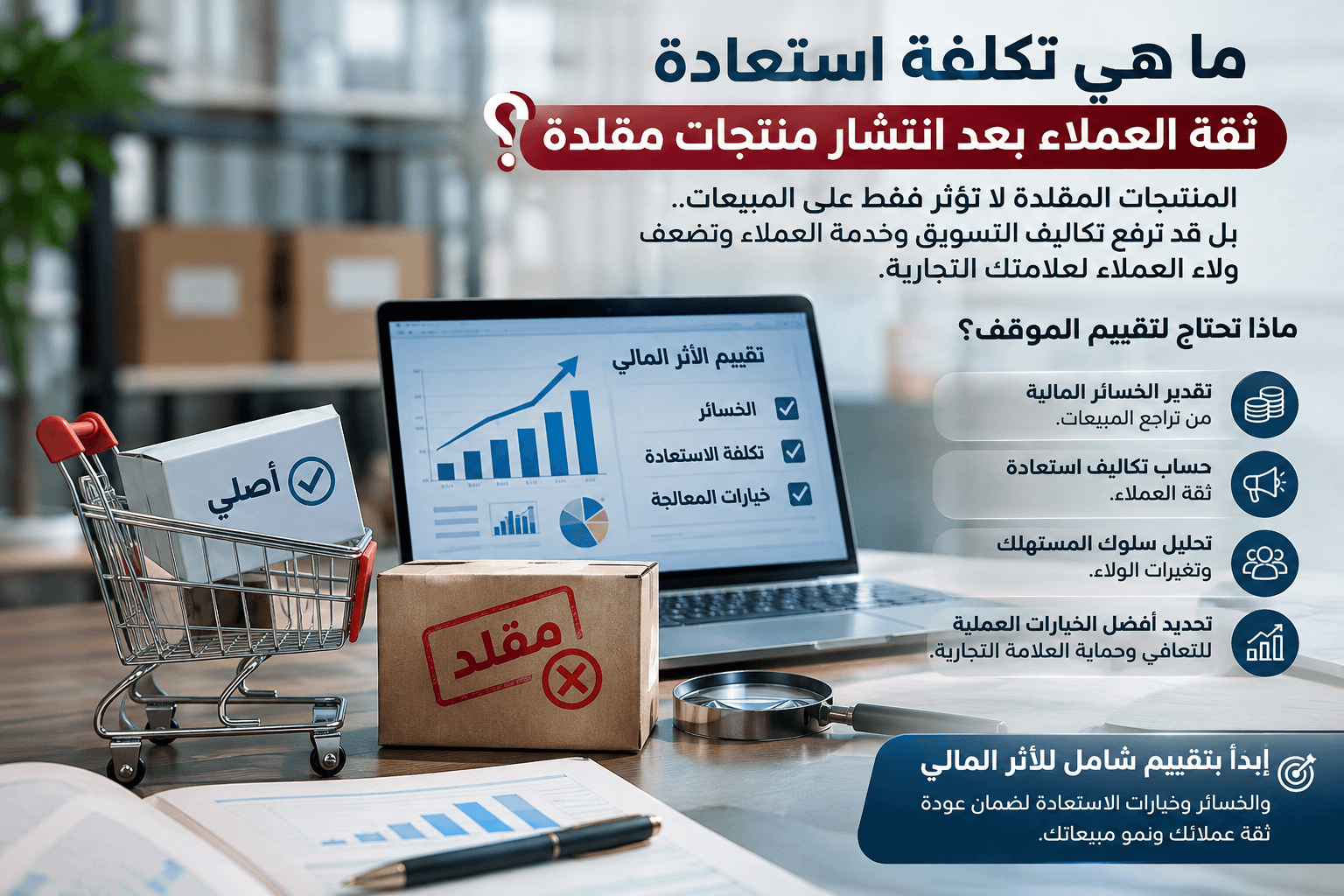
How Does Trademark Counterfeiting Affect Business Financial Performance?#
A company may experience an unexpected decline in product sales despite maintaining consistent marketing expenditure, product quality, and pricing strategies. Further market analysis may reveal counterfeit products carrying its trademark or unauthorized online accounts promoting imitation goods as genuine products.
In such situations, the challenge extends beyond ordinary market competition. Counterfeit sellers may benefit from the established reputation of the original trademark while diverting potential customers away from legitimate distribution channels.
The economic impact varies depending on the product category, the availability of counterfeit goods, price differences between genuine and imitation products, and consumers' ability to distinguish authentic products from counterfeits.
Therefore, estimating trademark counterfeiting losses requires more than simply comparing sales figures before and after counterfeit products appeared. It involves assessing the actual financial consequences while accounting for other market factors.
What Are the Main Financial Losses Caused by Counterfeit Products?#
The financial consequences of trademark counterfeiting may affect several aspects of business performance.
1. Direct Sales Losses#
Direct sales losses occur when consumers purchase counterfeit products instead of genuine alternatives, often because of lower prices or the mistaken belief that the products are authentic.
However, not every counterfeit purchase represents a lost sale for the original manufacturer. Some consumers buying lower-priced imitation products may not have been willing to purchase genuine products at their regular prices.
For this reason, businesses must estimate the proportion of counterfeit purchases that would realistically have converted into genuine product sales.
2. Declining Market Share#
The widespread availability of counterfeit products can weaken a brand's competitive position, particularly when imitation goods are distributed through multiple online marketplaces and retail channels.
However, market share losses should not automatically be attributed to counterfeiting.
Changes in consumer preferences, legitimate competition, economic conditions, and pricing strategies may also influence market performance.
A reliable assessment must distinguish counterfeiting-related losses from broader market developments.
3. Damage to Brand Reputation and Consumer Trust#
Consumers who unknowingly purchase low-quality counterfeit products may associate their negative experiences with the genuine brand.
This can affect customer satisfaction, repeat purchase rates, online reviews, and consumers' willingness to recommend the brand to others.
Over time, declining consumer confidence may create additional financial pressure, even after counterfeit products have been removed from certain distribution channels.
4. Increased Marketing and Operational Costs#
Companies affected by counterfeiting may need to allocate additional resources to marketplace monitoring, customer communication, product authentication, and awareness campaigns.
These measures may be necessary to restore consumer confidence and help customers identify authorized sellers.
Where a clear connection can be established, such additional expenditures may form part of the broader economic cost of counterfeiting.
How Can Businesses Estimate Financial Losses from Counterfeit Products?#
The financial assessment begins by determining the sales a company could reasonably have expected under normal market conditions and comparing them with actual performance.
Several analytical steps can support this process.
Step 1: Analyze Historical Sales Data
Companies should review sales performance across appropriate periods before and after counterfeit products entered the market.
The analysis should consider seasonal demand, promotional campaigns, pricing changes, and historical growth patterns.
Step 2: Examine Counterfeit Market Activity
Businesses should gather available information about counterfeit product distribution channels, estimated sales volumes, pricing, and geographic reach.
This helps identify the areas where counterfeit activity may have the greatest commercial impact.
Step 3: Study Consumer Purchasing Behavior
Consumer surveys, customer interviews, online reviews, and purchasing behavior analysis can help determine whether consumers confuse counterfeit products with genuine ones.
These findings may also support estimates of how many counterfeit buyers would otherwise have purchased authentic products.
Step 4: Calculate Estimated Lost Profit
The financial impact can be estimated using the number of genuine product sales potentially lost and the contribution margin associated with each sale.
A simplified calculation is:
Estimated Lost Profit = Estimated Genuine Units Lost × Contribution Margin per Unit
The contribution margin reflects revenue per unit after deducting relevant variable costs.
This calculation is only one component of a broader financial assessment. Reliable estimates require credible data, reasonable assumptions, and consideration of alternative explanations for declining sales.
Practical Example: Estimating Counterfeiting Losses#
Consider a hypothetical personal care company whose market research identifies approximately 10,000 counterfeit units sold during a particular period.
After analyzing consumer purchasing behavior, the company estimates that 40% of those buyers would have purchased the genuine product if counterfeit alternatives had not been available.
Assume the contribution margin on each genuine product is EGP 80.
The preliminary financial calculation would be:
Financial Indicator | Hypothetical Value |
|---|---|
Estimated counterfeit units sold | 10,000 units |
Estimated conversion to genuine purchases | 40% |
Estimated genuine sales lost | 4,000 units |
Contribution margin per genuine unit | EGP 80 |
Estimated lost profit | EGP 320,000 |
These figures are illustrative and do not represent an actual market study.
The estimated EGP 320,000 excludes potential reputational damage and additional costs associated with addressing the counterfeit activity.
It should not be treated as a definitive financial loss assessment or sufficient evidence on its own to establish a legal compensation claim.
How Can a Company Measure the Impact of Counterfeiting on Market Share?#
Sales figures alone may not fully explain the economic consequences of counterfeiting.
A business might experience declining sales while the entire market is contracting. Alternatively, its sales could increase while its market share decreases because competitors are growing faster.
To understand these developments, businesses should monitor several indicators:
Market Share: The brand's sales as a proportion of total sales within the defined market.
Customer Churn Rate: The percentage of customers who stop purchasing the company's products during a specified period.
Repeat Purchase Rate: The frequency with which existing customers continue purchasing genuine products.
Brand Awareness: Consumers' ability to recognize the authentic brand and distinguish genuine products from imitations.
Price Gap Analysis: The difference between genuine and counterfeit product prices and its influence on purchasing decisions.
Defining the relevant market accurately is essential.
Product categories, geographic locations, customer segments, and distribution channels should be consistently identified to avoid misleading comparisons.
What Commercial Strategies Can Reduce Counterfeiting Losses?#
The most appropriate response depends on the scale of the financial damage, the cost of intervention, and the expected commercial benefits.
Companies may consider strengthening product authentication methods, reviewing distributor relationships, monitoring online sales channels, and improving communication with consumers about authorized sellers.
Other situations may require reallocating marketing budgets, focusing on heavily affected markets, or reviewing pricing and distribution strategies.
Businesses should also compare the expected costs of corrective measures with the financial losses those measures could prevent.
Scenario analysis can help decision-makers evaluate multiple options under different assumptions rather than relying on a single estimate.
Legal measures against unauthorized trademark use may complement these commercial strategies. Documenting counterfeit activity and assessing financial damage can support decisions about brand protection and potential claims where the applicable legal requirements are satisfied.
The Role of Market Research and Consumer Behavior Analysis#
Professional Market Research, Consumer Behavior Analysis, and Competitor Analysis services provide businesses with a structured approach to assessing the economic consequences of trademark counterfeiting.
Such assessments may include historical sales reviews, competitor and pricing analysis, consumer surveys, and financial models comparing actual business performance with estimated performance in the absence of counterfeiting.
Market research can also help businesses identify where counterfeit goods are most prevalent and which customer segments are most affected.
By combining quantitative financial data with consumer insights, companies can better understand the scale of potential losses, prioritize corrective actions, and allocate resources more effectively.
These findings can support informed commercial decisions and provide useful economic analysis when evaluating available legal and business options.
Conclusion: Protecting Brand Value Begins with Measuring Financial Damage#
The financial consequences of trademark counterfeiting extend beyond immediate lost sales.
Counterfeit products may weaken market positioning, undermine consumer confidence, and increase the costs associated with maintaining brand reputation.
A reliable assessment should combine financial analysis, market research, and consumer behavior studies while distinguishing losses attributable to counterfeiting from ordinary market fluctuations.
If your brand is facing counterfeit products, unauthorized trademark use, or declining sales potentially linked to imitation goods, request a professional financial impact assessment to evaluate potential losses and identify practical commercial solutions.