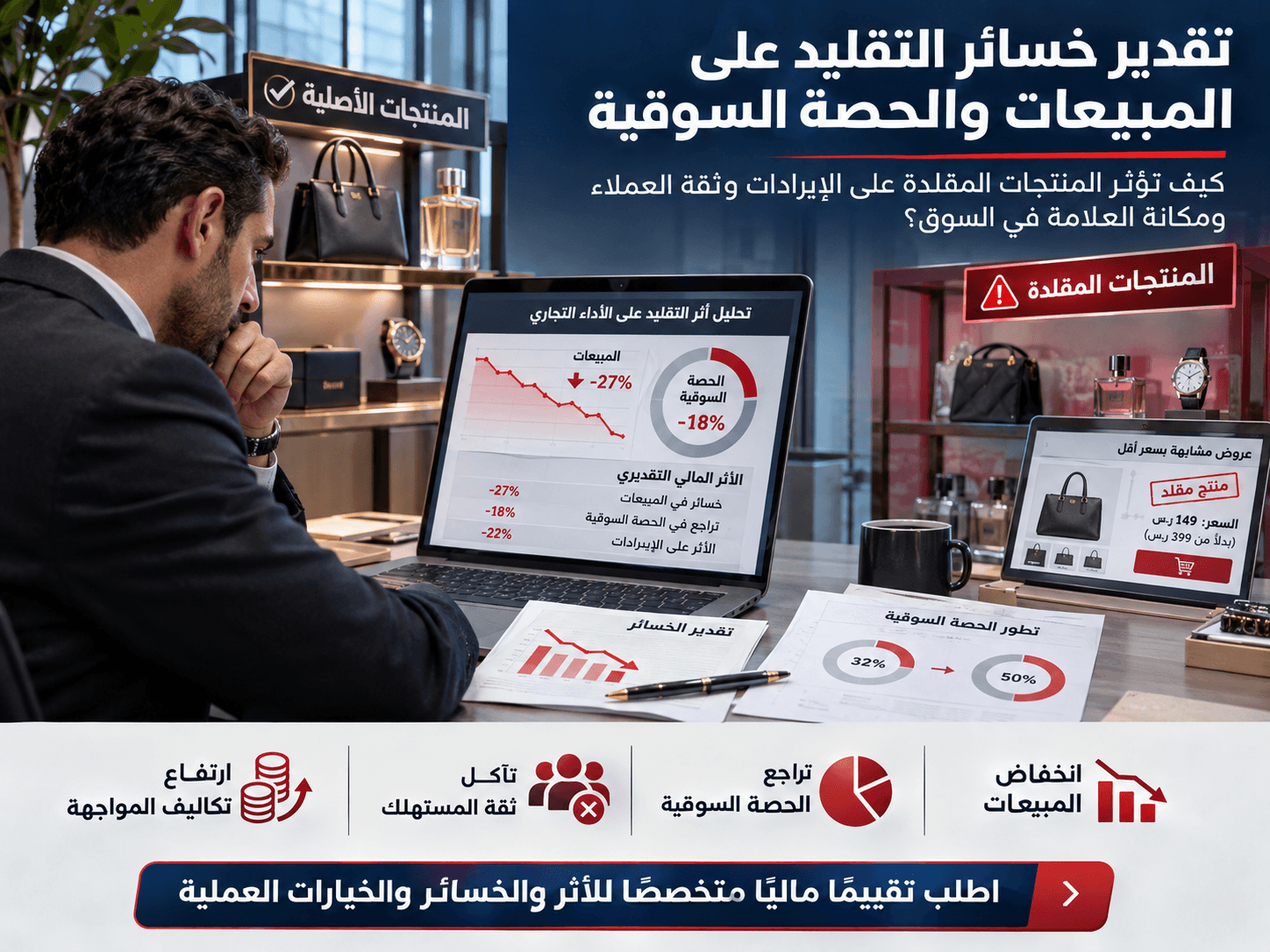
How Do Counterfeit Products Affect Customer Trust?#
When consumers purchase a product carrying a recognizable brand name and discover that its quality falls below expectations, they may associate their negative experience with the original brand, even if the product is counterfeit.
This problem becomes more serious when counterfeit products appear on e-commerce platforms or social media accounts that imitate legitimate businesses.
The financial consequences are not limited to sales diverted toward unauthorized products. Counterfeiting can also reduce repeat purchases, increase customer complaints, and weaken the effectiveness of marketing campaigns.
Businesses may consequently need to allocate additional resources to educating customers, explaining how to identify authentic products, and rebuilding confidence in their quality.
This raises an important commercial question: How much does it cost to restore customer trust after counterfeit products spread, and how can businesses evaluate the financial return on their recovery investments?
What Costs Do Businesses Face After Counterfeit Products Enter the Market?#
The cost of restoring customer confidence depends on several factors, including brand size, product category, the extent of counterfeiting, and the impact on consumer perceptions.
These costs can generally be divided into four categories.
1. Lost Sales and Customer Revenue#
Counterfeit products may reduce legitimate sales when customers purchase cheaper imitations or avoid buying altogether because they are uncertain about product authenticity.
However, declining revenue alone does not establish the financial impact of counterfeiting.
Businesses must distinguish losses attributable to counterfeit products from other influences, such as seasonal demand, pricing changes, economic conditions, and legitimate competition.
2. Corrective Marketing Campaigns#
Companies may need to launch targeted awareness campaigns to explain how customers can identify genuine products and locate authorized distribution channels.
These expenses may include digital advertising, content production, public communication, social media management, and reputation recovery initiatives.
The effectiveness of these campaigns should be measured against improvements in customer confidence and purchasing behavior.
3. Increased Customer Service Expenses#
Counterfeit products can generate additional complaints, warranty inquiries, and questions about product authenticity.
Businesses may need to dedicate more employees, technology, and operational resources to handling these issues.
They may also need to establish clear procedures for responding to consumers who have unknowingly purchased counterfeit products.
4. Preventive and Brand Protection Costs#
Companies may invest in product authentication systems, distribution monitoring, packaging verification technologies, and marketplace surveillance.
These measures can help reduce future exposure to counterfeit products.
However, their financial value should be assessed against the potential losses they are intended to prevent.
How Can Businesses Calculate the Cost of Restoring Customer Trust?#
An effective financial assessment should distinguish between losses already incurred and the additional investments required to restore customer confidence.
A practical estimation model is:
Estimated Total Economic Impact = Lost Profit Contribution from Counterfeit-Related Sales + Customer Complaint Management Costs + Customer Trust Recovery Expenses + Additional Preventive Measures.
Businesses should avoid double-counting costs and distinguish documented financial losses from projected estimates.
Practical Example: Estimating Brand Recovery Costs#
Consider a hypothetical consumer goods company experiencing declining sales and customer confidence after counterfeit versions of its products enter the market.
Cost Category | Estimated Cost (EGP) |
|---|---|
Lost profit attributable to counterfeiting | 150,000 |
Corrective marketing campaigns | 60,000 |
Customer service and complaint management | 25,000 |
Additional authentication and monitoring measures | 35,000 |
Total Estimated Economic Impact | 270,000 |
These figures are hypothetical and are provided for illustration only. They do not represent actual market statistics.
The example demonstrates that restoring customer trust may account for a substantial portion of the overall economic impact of counterfeiting.
However, total economic losses should not be confused with the recovery budget itself.
Furthermore, increased spending does not guarantee that sales or customer confidence will return to their previous levels.
How Can Market Research Measure the Damage to Brand Reputation?#
Sales data alone may not fully explain how counterfeit products affect consumer confidence.
A company may experience relatively stable sales while customer loyalty, repeat purchase intentions, or perceptions of authenticity gradually deteriorate.
Market research and consumer behavior analysis can help businesses identify these changes by examining:
Customer awareness of counterfeit products.
Consumer experiences with suspected counterfeit purchases.
Reasons for declining brand confidence.
Changes in customer perceptions before and after counterfeiting incidents, where reliable baseline data is available.
The influence of pricing, distribution channels, and competitors on purchasing decisions.
These findings help businesses identify the customer segments most affected by counterfeiting.
They also support more efficient allocation of marketing and recovery budgets.
What Practical Steps Can Businesses Take to Restore Customer Trust?#
Restoring customer confidence requires more than launching advertising campaigns.
An effective recovery strategy should address the sources of the problem while improving customer experiences.
Step 1: Identify the Sources of Counterfeit Products#
Businesses should investigate the marketplaces, sellers, distribution channels, and social media accounts through which counterfeit products are being offered.
Understanding the scale and distribution of the problem helps determine which corrective measures deserve priority.
Step 2: Clarify Authorized Sales Channels#
Companies should clearly communicate where customers can purchase genuine products.
Providing information about authorized distributors, official stores, and product authentication methods can reduce uncertainty and support informed purchasing decisions.
Step 3: Address Affected Customer Experiences#
Businesses should review complaints involving suspected counterfeit products and establish appropriate response procedures.
Transparent communication and practical customer guidance can help limit further reputational damage.
Step 4: Develop Targeted Awareness Campaigns#
Instead of increasing advertising expenditure without a clear strategy, businesses should prioritize consumer groups whose confidence or purchasing intentions have been most affected.
Market research can help identify these audiences and determine the messages most likely to address their concerns.
Step 5: Monitor Recovery Performance#
Companies should regularly evaluate indicators such as:
Repeat purchase rates.
Customer satisfaction levels.
Complaint volumes.
Customer acquisition costs.
E-commerce conversion rates.
Customer retention and brand perception.
These measurements allow businesses to assess recovery performance and adjust spending based on observable results.
When Can Brand Recovery Costs Exceed Direct Sales Losses?#
In some circumstances, the cost of restoring consumer confidence may exceed the immediate profit losses associated with counterfeit sales.
This is particularly relevant when a business depends on repeat customers, operates in a product category where trust is essential, or faces widespread impersonation across digital marketplaces.
In such cases, the negative effects on consumer perceptions may continue even after counterfeit listings are removed.
Companies may need to maintain additional marketing, customer support, and authentication investments before confidence indicators recover.
For this reason, financial assessments should consider different recovery scenarios rather than assuming that sales will automatically return to previous levels once counterfeiting activity stops.
The Role of Market Research and Consumer Behavior Analysis in Brand Recovery#
Professional market research, consumer behavior analysis, and competitor analysis help businesses translate the consequences of counterfeiting into measurable commercial decisions.
These services can support businesses by examining changes in purchasing behavior, evaluating market share movements, estimating financial losses, and identifying customer segments most vulnerable to declining confidence.
They can also help develop financial scenarios comparing corrective marketing campaigns, improved customer experiences, and investments in distribution channel protection.
This analytical approach enables businesses to prioritize expenditures and assess recovery options before committing substantial financial resources.
In certain circumstances, a parallel legal assessment may also be necessary to address unauthorized trademark use and reduce the risk of continuing infringement.
Combining financial analysis with appropriate commercial and legal measures can provide a more comprehensive response to the problem.
Conclusion: Restoring Customer Trust Requires Financial Planning and Measurable Action#
The economic consequences of counterfeit products extend beyond immediate sales losses.
Businesses may also experience higher marketing costs, increased customer service expenses, reduced brand loyalty, and long-term reputational challenges.
An effective response begins with identifying the scale of the damage, understanding changes in consumer behavior, estimating recovery costs, and selecting strategies that offer the strongest potential return on investment.
If your business has been affected by counterfeit products or unauthorized accounts impersonating your brand, a comprehensive financial and commercial assessment of the impact, losses, and available recovery options can help you determine the extent of the problem and develop a practical strategy to rebuild customer confidence and protect your brand's economic value.