
From Holding Rates Steady to Expectations of Further Increases: What Has Changed?#
The Federal Reserve is approaching the final weeks of 2026 facing a significant economic challenge: controlling inflation without triggering a sharp slowdown in economic activity.
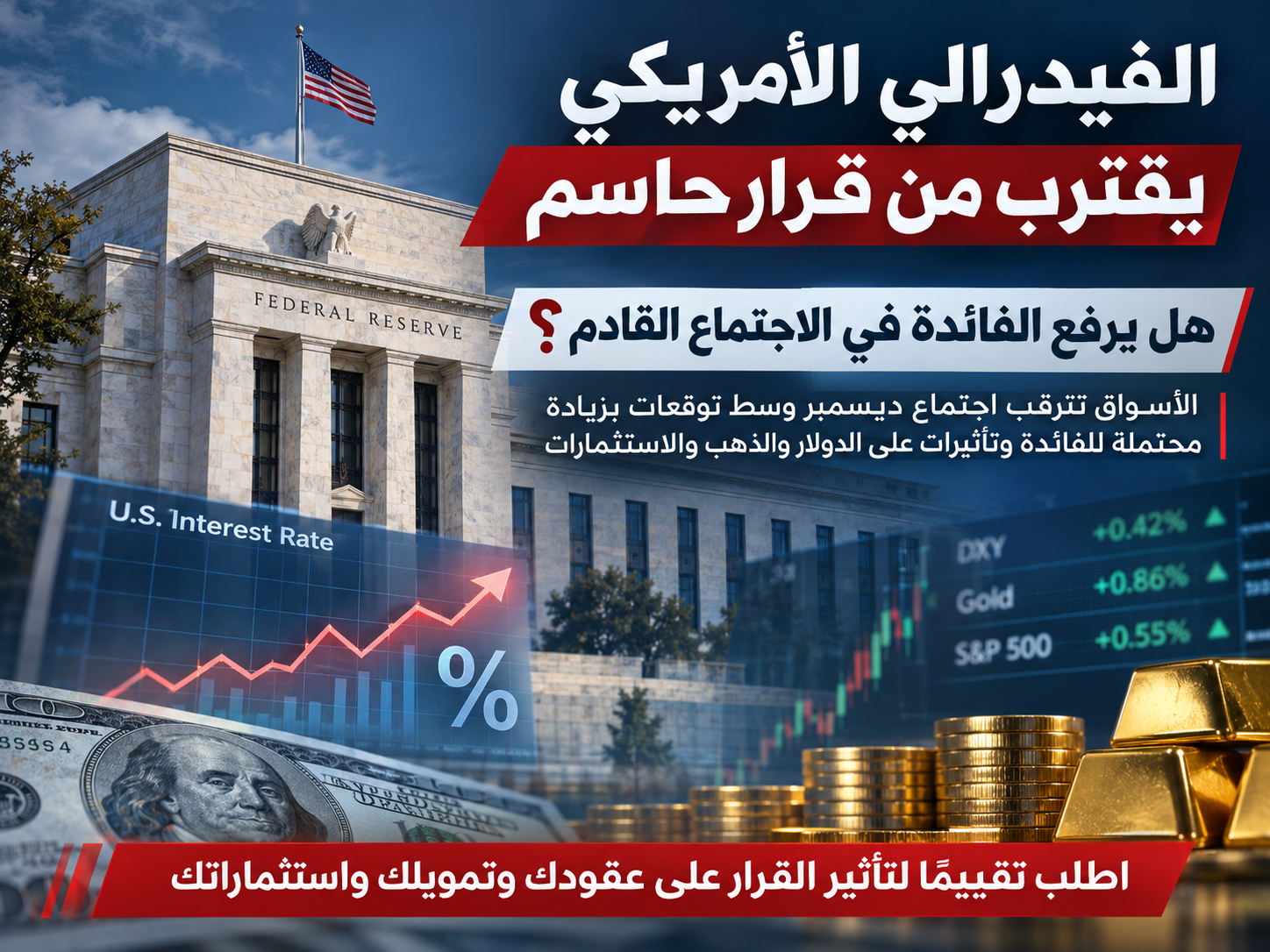
After maintaining its benchmark interest rate within the 3.75%–4.00% range during its October 27–28 meeting, the central bank released meeting minutes on November 18 that indicated broad support among policymakers for additional monetary tightening.
According to the minutes, ten members voted to maintain interest rates, while two preferred an increase of 25 basis points.
However, the more significant development concerned policymakers' assessment of the coming months.
Most participants considered further interest rate increases potentially necessary to bring inflation back toward the Federal Reserve's 2% target.
This outlook has strengthened expectations that the central bank may continue tightening monetary policy rather than maintaining its current interest rate levels.
December 9 Meeting: Is Another Rate Increase Becoming Increasingly Likely?#
Current market expectations suggest that a 25-basis-point increase is the leading scenario for the Federal Reserve's upcoming December meeting.
According to market pricing reported as of November 21, 2026, the implied probability of a quarter-percentage-point increase stood at approximately 93%.
However, this figure represents market expectations rather than a guaranteed policy outcome.
Such probabilities can change significantly as new economic data becomes available.
If the Federal Reserve increases interest rates by 25 basis points, the target range would rise from 3.75%–4.00% to 4.00%–4.25%.
A more aggressive possibility would involve a 50-basis-point increase.
Some policymakers have indicated that a larger adjustment could become appropriate if incoming inflation data proves unfavorable.
Nevertheless, this remains an alternative scenario rather than the primary outcome currently reflected in market expectations.
Why Is the Federal Reserve Still Concerned About Inflation?#
Federal Reserve officials remain focused on inflationary pressures that continue to exceed the central bank's long-term target.
Persistent inflation, combined with resilient economic activity and consumer spending, has complicated the outlook for monetary policy.
The central bank faces a difficult balancing act.
Keeping interest rates too low could allow inflation to remain elevated, while increasing rates too aggressively could raise borrowing costs and place additional pressure on households and businesses.
On November 20, 2026, Federal Reserve Governor Lisa Cook supported the case for additional rate increases, suggesting that the current level of interest rates might not be sufficiently restrictive to address ongoing inflationary pressures.
These developments reinforce the significance of the December meeting in determining the direction of U.S. monetary policy.
Could Interest Rate Increases Continue Into 2027?#
Discussions surrounding the Federal Reserve's monetary policy are no longer limited to the December meeting.
According to a Reuters report dated November 19, JPMorgan anticipated interest rate increases across the Federal Reserve's next three meetings, reflecting expectations that inflationary pressures could require further tightening.
This forecast illustrates a shift in how some major financial institutions view the future direction of U.S. interest rates.
However, it remains an institutional economic forecast rather than an official announcement of future Federal Reserve decisions.
Monetary policy in 2027 will ultimately depend on incoming inflation figures, employment conditions, economic growth, and broader financial risks.
How Could Higher Interest Rates Affect the Dollar, Gold, and Global Markets?#
1. The U.S. Dollar#
Higher U.S. interest rates can increase the attractiveness of dollar-denominated assets by offering investors relatively higher returns.
This may strengthen demand for the U.S. dollar, particularly when interest rate differentials favor American financial assets.
However, exchange rates are also influenced by global economic conditions, investor expectations, and geopolitical developments.
2. Gold Prices#
Higher interest rates and rising bond yields can place downward pressure on gold because the metal does not generate periodic income.
As yields on interest-bearing assets increase, the opportunity cost of holding gold may rise.
Nevertheless, geopolitical uncertainty, financial instability, and demand for safe-haven assets can continue to support gold prices even during periods of monetary tightening.
3. Stock Markets and Corporate Investment#
Higher borrowing costs may affect corporate valuations, particularly for companies dependent on external financing or future growth expectations.
Businesses considering expansion projects may also face increased financing expenses, potentially influencing investment decisions and profitability forecasts.
4. Emerging Markets#
Additional U.S. monetary tightening could create challenges for emerging economies.
Potential consequences include changes in international capital flows, increased external borrowing costs, and greater exchange rate volatility.
The magnitude of these effects will vary depending on each economy's financial conditions and exposure to international markets.
What Could the Federal Reserve's Decision Mean for Egyptian Businesses?#
For companies operating in Egypt, changes in U.S. monetary policy may have consequences extending beyond international financial markets.
Egyptian importers purchasing raw materials, machinery, or industrial equipment in U.S. dollars could face additional risks related to currency fluctuations and trade financing costs.
Companies relying on dollar-denominated loans or floating-rate financing arrangements may also be exposed to changes in international borrowing costs.
From a legal and contractual perspective, these developments highlight the importance of reviewing financing agreements, variable interest provisions, repayment schedules, currency-related obligations, and contractual risk allocation mechanisms.
Companies should also evaluate how changes in global financial conditions could affect cash flow, procurement costs, and contractual performance.
However, a Federal Reserve interest rate increase does not automatically require a corresponding increase in Egyptian interest rates.
The Central Bank of Egypt makes its monetary policy decisions based on domestic economic conditions, inflation expectations, and other relevant indicators.
Three Possible Scenarios for the December Federal Reserve Meeting#
Scenario One: A 25-Basis-Point Increase
This represents the leading scenario reflected in the market expectations discussed above.
Such a decision could indicate that the Federal Reserve intends to maintain monetary tightening at a gradual pace while continuing to monitor inflation and economic activity.
Scenario Two: A 50-Basis-Point Increase
A larger increase would represent a more aggressive monetary policy response.
This scenario could become relevant if inflation data indicates persistent or worsening price pressures.
However, it is not the primary outcome currently reflected in market pricing.
Scenario Three: Interest Rates Remain Unchanged
The Federal Reserve could also decide to maintain the current interest rate range if economic data or financial risks support delaying another increase.
Although this scenario appears less favored by the cited market expectations, it cannot be excluded before the official policy announcement.
Conclusion: Could the Federal Reserve Reshape Global Investment Decisions?#
As the December meeting approaches, the central question is no longer limited to whether the Federal Reserve will increase interest rates.
Investors and businesses are increasingly focused on how long monetary tightening may continue and what its consequences could be for the global economy.
Further rate increases may influence currency movements, commodity prices, borrowing costs, and investment decisions across international markets.
For businesses, these developments reinforce the importance of reviewing financing commitments, assessing currency exposure, evaluating contractual obligations, and preparing for different economic scenarios.
Could the Federal Reserve's upcoming decisions affect your company's financing agreements or commercial contracts?
A comprehensive legal and financial assessment can help businesses identify potential risks, evaluate their contractual exposure, and develop appropriate strategies before changing market conditions affect their operations.


