
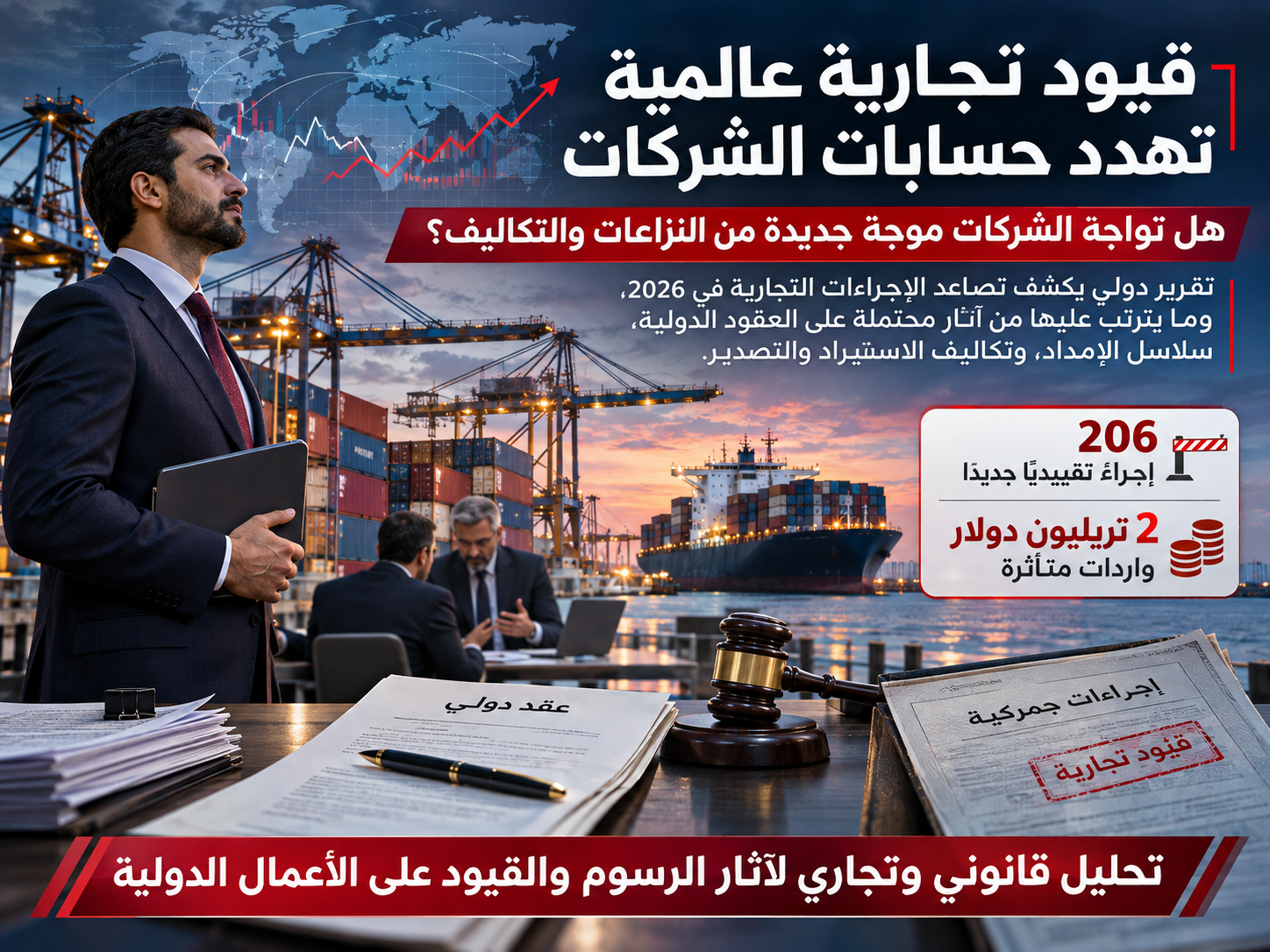
Trillions of Dollars in Global Trade Face Restrictions: What Is Happening?#
International trade challenges are no longer limited to rising transportation costs or currency fluctuations. Changes in trade policies, customs tariffs, and import and export restrictions are increasingly influencing the financial calculations of businesses, sometimes after commercial agreements have already been finalized.
In a development highlighting the scale of these challenges, the World Trade Organization published its 33rd report on G20 trade measures on November 23, 2026.
The report revealed that G20 economies introduced 206 new trade-restrictive or non-facilitating measures during the first half of 2026, compared with 194 measures throughout the entirety of 2025.
More significantly, the cumulative value of G20 imports affected by trade-restrictive and non-facilitating measures introduced since 2009 and still in force reached approximately $4.5 trillion by the end of June 2026.
This represented approximately 29.6% of total G20 imports.
These figures do not mean that all affected trade has been prohibited. Rather, they demonstrate the expanding scope of regulatory measures that may influence international transactions, market access, and the costs of cross-border commercial activities.
What Do the Latest WTO Figures Reveal?#
206
New trade-restrictive or non-facilitating measures in H1 2026
$4.5T
G20 imports covered by cumulative restrictions still in force
29.6%
Share of total G20 imports covered by cumulative restrictions
282
Trade-facilitating measures introduced in H1 2026
Source: WTO report published November 23, 2026, covering developments through June 30, 2026.
Interestingly, the report did not identify an increase in trade restrictions alone.
It also recorded 282 trade-facilitating measures during the first six months of 2026, exceeding the 225 such measures introduced throughout 2025.
This contrast reveals a complicated international trade environment.
While some governments are imposing additional restrictions on certain products or industries, others are simultaneously introducing measures designed to simplify trade procedures and improve market access.
For businesses, this rapidly changing regulatory landscape makes monitoring international trade policies an essential component of corporate risk management.
How Could Trade Restrictions Trigger Legal Disputes Between Companies?#
The legal implications of changing trade policies become particularly significant when new regulations affect commercial agreements that have already been signed.
Consider a company that enters into an international supply contract based on a specific purchase price and expected import cost.
If additional customs tariffs or regulatory restrictions are introduced before the shipment arrives, the importer may face unexpected financial obligations.
Meanwhile, the supplier may insist on enforcing the original contractual terms and refuse to absorb the additional expenses.
Such disagreements can develop into commercial disputes when the parties cannot agree on cost allocation, contract adjustments, or revised delivery schedules.
However, the introduction of new trade restrictions does not automatically transfer legal responsibility to a particular party.
Determining liability requires careful examination of the contract, the applicable legal framework, and the specific nature of the regulatory changes.
Important contractual provisions may include price adjustment clauses, customs duty allocation, delivery terms, changes in law, force majeure, and hardship provisions where legally applicable.
Can Businesses Renegotiate Contracts Following New Customs Tariffs?#
Contract renegotiation may become an important option when regulatory developments substantially affect the economic conditions under which commercial agreements were concluded.
Nevertheless, increasing costs do not automatically grant businesses the legal right to modify or terminate their contractual obligations.
If an international supply agreement includes a price adjustment clause covering changes in customs tariffs, the parties may be able to apply that provision according to its specific conditions.
Where such contractual protection is absent, the available options may depend on the governing law and whether doctrines relating to hardship, changed circumstances, or other legal remedies apply.
It is also essential to distinguish between increased performance costs and legal or practical impossibility of performance.
These circumstances may carry different legal consequences depending on the jurisdiction and contractual framework.
For this reason, carefully drafted international commercial agreements can play a significant role in clarifying how regulatory risks and additional expenses should be allocated before disputes arise.
Which Businesses Are Most Exposed to Rising Trade Restrictions?#
The potential impact of international trade restrictions varies according to the nature of a company's operations, its supply chain structure, and the markets in which it operates.
Importing Companies
Importers may experience higher procurement costs, additional customs documentation requirements, and increased pressure to identify alternative suppliers.
Exporting Companies
Exporters may face reduced competitiveness in foreign markets if new tariffs or regulatory restrictions increase the final cost of their products.
Shipping and Logistics Companies
Logistics providers may encounter changes in shipping patterns, operational costs, customs procedures, and contractual disputes involving delays or delivery obligations.
Manufacturing Companies
Manufacturers that rely on internationally sourced raw materials and components may face increased production costs or difficulties maintaining established supply arrangements.
Investors and Multinational Businesses
International investors may need to reassess exposure to foreign markets, long-term supply agreements, and commercial activities affected by changing trade regulations.
These consequences remain potential risks rather than universal outcomes. Their actual impact depends on the specific restrictions, products, countries, and contracts involved.
What Could These Developments Mean for Egyptian Businesses?#
Although the WTO report focuses on G20 economies, changes in international trade policies may indirectly affect Egyptian companies participating in global supply chains.
An Egyptian manufacturer importing raw materials from international suppliers, for example, may need to reassess procurement costs if relevant trade regulations change.
Similarly, Egyptian exporters selling products to markets affected by additional restrictions may need to review pricing strategies, delivery obligations, and contractual arrangements.
Businesses may also need to consider alternative sourcing markets, renegotiate selected commercial agreements, or strengthen contractual protections against future regulatory developments.
However, the WTO report does not establish that particular new tariffs have been imposed on all Egyptian exports or imports.
Any assessment of the direct impact on an Egyptian business must consider the relevant product, country, trade measure, and applicable contractual terms.
Is Global Trade Entering a More Complicated Phase?#
The latest figures do not necessarily indicate that international trade is moving uniformly toward market closure.
Despite the accumulation of trade restrictions, trade-facilitating measures have also increased, suggesting that governments continue to pursue different commercial and regulatory priorities.
The WTO report also highlighted the resilience of merchandise trade during the first half of 2026.
In October 2026, the organization raised its forecast for global merchandise trade volume growth in 2026 to 3.9%, compared with an earlier baseline forecast of 1.9%.
This suggests that the central challenge for businesses may not be the complete interruption of international trade, but rather the need to operate within an increasingly complex and changing regulatory environment.
For companies engaged in cross-border transactions, flexibility and legal preparedness may become essential elements of long-term commercial planning.
What Should Companies Do to Protect Their Commercial Interests?#
These developments highlight the importance of addressing international trade risks before they develop into financial losses or contractual disputes.
Businesses should begin by reviewing existing commercial agreements, particularly provisions concerning pricing, delivery obligations, customs duties, regulatory changes, and dispute resolution.
They should also monitor trade regulations affecting their products and target markets, assess potential financial exposure, and evaluate the effects of changing costs on liquidity and profitability.
Where appropriate, companies may consider developing alternative procurement strategies, reducing excessive dependence on individual suppliers, and incorporating clearer renegotiation mechanisms into future contracts.
When commercial disagreements have already emerged, specialized legal advice can help companies examine contractual obligations, evaluate available remedies, and explore appropriate dispute resolution strategies.
Conclusion: The Real Challenge Is Not Just Higher Tariffs, but Contracts Unprepared for Change#
The World Trade Organization's latest report demonstrates that increasing trade restrictions represent a challenge extending beyond customs procedures and international shipping costs.
Changes in global trade policies may influence supply agreements, financial obligations, delivery schedules, and relationships between importers and exporters.
As international regulations continue to evolve, reviewing commercial contracts and strengthening legal risk management can help businesses maintain operational stability and reduce exposure to costly disputes.
Could your company's import or export agreements be affected by newly introduced tariffs or international trade restrictions?
Specialized legal and commercial consultancy can help assess the implications of regulatory changes, review international contracts, clarify liability for additional costs, and evaluate practical strategies for protecting business interests and investments.


