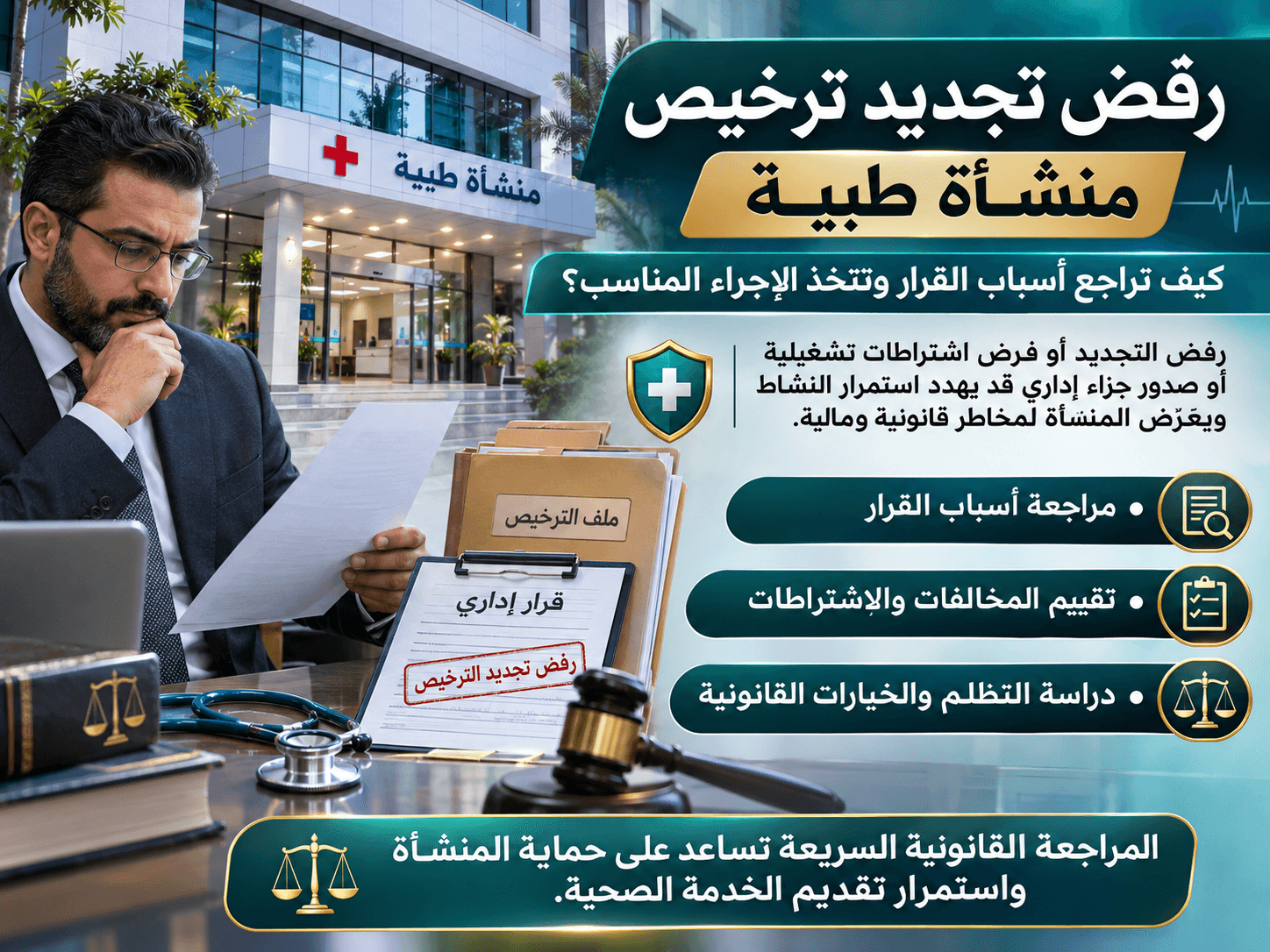
1. When Can an Operational Violation Threaten a Medical Facility's License?#
A routine regulatory inspection may uncover an operational issue that initially appears minor. However, depending on its nature and severity, that issue could develop into a formal investigation, an administrative penalty, or a potential closure order.
This raises an important legal question: Does every operational violation justify an administrative penalty, or must regulatory authorities follow specific legal procedures before taking action?
The answer depends on several factors, including the nature of the violation, the applicable legal provisions, the authority responsible for enforcement, and the potential risks to patient safety.
Not all operational violations carry the same legal consequences. Similarly, not every regulatory finding automatically justifies suspension or closure.
Healthcare administrators must therefore evaluate each alleged violation individually rather than treating regulatory notices as routine administrative matters.
2. What Is the Legal Framework Governing Medical Facility Violations in Egypt?#
The primary legislative framework regulating private medical establishments in Egypt includes Law No. 51 of 1981 concerning the Regulation of Medical Establishments, as amended by Law No. 153 of 2004.
These laws establish important requirements relating to medical facility licensing, operational conditions, regulatory inspections, and certain penalties for non-compliance.
Article 11 provides for inspections of medical establishments at least once annually to verify compliance with applicable requirements. It also addresses notifying facility management of identified violations and allowing a period of up to 30 days for their correction.
In cases involving serious violations, the law permits administrative closure by the competent governor upon submission by the relevant health authority.
However, the availability of a corrective period does not necessarily apply uniformly to every violation. Serious breaches and circumstances governed by specific legal provisions may require different enforcement measures.
Depending on the nature of their activities, medical establishments may also be subject to additional licensing conditions, professional requirements, infection-control regulations, and applicable healthcare accreditation standards.
Understanding the precise legal framework is essential before determining whether an administrative measure is justified.
3. Which Operational Violations Can Lead to Regulatory Investigations?#
Operational violations may arise from several areas of medical facility management.
Examples include:
Failure to maintain required licensing conditions.
Performing medical activities beyond the scope of an existing license.
Inadequate infection prevention and control procedures.
Failure to comply with applicable safety and equipment requirements.
Deficiencies involving medical personnel or professional authorizations.
Improper medical waste management.
Operating specialized equipment without required approvals.
The legal consequences depend on the specific regulatory requirement, the circumstances surrounding the alleged breach, and the potential impact on patients and healthcare professionals.
A violation may become particularly serious when it presents an immediate threat to health and safety, continues after a formal corrective notice, or involves activities conducted without the necessary authorization.
Consequently, medical facilities should not automatically deny every allegation. Instead, management should establish what occurred, assess the available evidence, and determine which legal provisions apply.
4. What Should a Medical Facility Do After Receiving an Inspection Report?#
The first step is to conduct a careful review of the regulatory document received.
Facility management should verify the identity and authority of the issuing body, the inspection date, the alleged violations, the relevant legal provisions, and any deadlines for responding or taking corrective action.
It is also essential to distinguish between an inspection report, a corrective notice, a request to provide information, a formal investigation notice, and an enforceable administrative decision.
Each document may require a different legal response.
A comprehensive regulatory file should include relevant documentation, such as the facility's operating license, applicable permits, previous inspection reports, official correspondence, maintenance records, internal compliance policies, and evidence relating to the alleged violation.
Where an actual deficiency exists, management should implement appropriate corrective measures promptly and document those measures accurately.
Records must not be concealed, altered retrospectively, or presented in a misleading manner.
A well-organized evidence file can substantially improve the quality of the facility's response and assist legal advisers in evaluating its position.
5. How Should a Medical Facility Prepare Its Legal Response?#
An effective legal response should address the specific allegations rather than rely on general statements that the facility complies with all regulatory requirements.
The response should explain the relevant facts, identify supporting documentation, and distinguish between allegations that are disputed and deficiencies that have been corrected.
For example, if the alleged violation concerns an authorization that was previously issued, the facility may provide the relevant approval and explain how it applies to the activity under investigation.
If the issue concerns equipment maintenance or operational procedures, management may submit maintenance reports, technical records, and evidence of corrective action.
A properly prepared response should also consider whether the alleged facts have been accurately recorded and whether the applicable regulatory provisions have been correctly interpreted.
The objective is not simply to reject an allegation. It is to establish a defensible legal position supported by reliable documentation.
Facilities should avoid unsupported accusations, inaccurate admissions, or explanations that contradict existing records.
6. Can Medical Facilities Challenge Administrative Penalties or Closure Orders?#
Depending on the applicable legal framework and the circumstances of the case, healthcare facilities may have access to administrative objections, grievances, or judicial challenges against certain regulatory decisions.
A legal assessment should examine whether the issuing authority had jurisdiction, whether mandatory procedures were followed, and whether the alleged violation is supported by sufficient evidence.
It should also consider whether the decision correctly applies the relevant law and complies with any applicable procedural safeguards.
Corrective actions undertaken by the facility may also be relevant when evaluating whether the reasons supporting a continuing administrative restriction remain applicable.
However, submitting an administrative grievance does not necessarily suspend enforcement of the contested decision.
Furthermore, the deadlines and procedures governing legal challenges may differ depending on the decision and the applicable legislation.
For this reason, any decision ordering closure, suspension, or restriction of operations should be reviewed promptly by qualified legal counsel.
Medical facilities should never assume that filing a challenge automatically authorizes continued operations.
7. How Can Healthcare Facilities Protect Business Continuity During Investigations?#
Regulatory investigations may create operational consequences extending beyond the immediate legal dispute.
A suspension affecting a particular department may disrupt patient appointments, contractual obligations, staffing arrangements, and the delivery of essential healthcare services.
Medical establishments should therefore approach regulatory investigations through a coordinated strategy combining legal compliance, corrective action, and operational risk management.
This may include determining which services can lawfully and safely continue, identifying departments affected by regulatory restrictions, reviewing outstanding patient commitments, and assigning responsibility for required corrective measures.
Where healthcare services must be interrupted, patient safety and continuity of necessary care should remain priorities.
Medical facilities must also respect enforceable closure or suspension orders and should not resume restricted activities before satisfying the relevant legal requirements.
A structured response can help reduce unnecessary disruption while supporting the facility's longer-term operational stability.
8. How Can Medical Facilities Prevent Repeated Operational Violations?#
Regulatory compliance should be an ongoing management responsibility rather than a reaction to an inspection.
Healthcare facilities can reduce their exposure to recurring violations by maintaining effective internal compliance systems.
These systems should include regular licensing reviews, scheduled maintenance procedures, documented infection-control practices, staff training, and periodic assessments of operational requirements.
Management may also establish a regulatory compliance register identifying each applicable obligation, the person responsible for monitoring it, the supporting documentation required, and the relevant review dates.
This approach is especially important for hospitals and multidisciplinary medical centers operating several departments or providing services requiring specialized approvals.
Proactive compliance management can help identify potential regulatory deficiencies before they escalate into formal investigations or enforcement actions.
9. When Should a Medical Facility Seek Specialized Legal Assistance?#
Specialized legal advice becomes particularly important when a healthcare establishment receives a serious violation notice, faces a formal regulatory investigation, or becomes subject to an administrative decision threatening its continued operations.
Legal review may also be necessary when there are discrepancies between licensed activities and actual operations, disagreements regarding regulatory interpretations, or overlapping requirements imposed by different authorities.
A specialized assessment can help facility management understand its legal position, identify weaknesses in the available documentation, evaluate corrective measures, and determine whether administrative or judicial remedies are appropriate.
Early legal intervention may also improve coordination between regulatory compliance efforts and broader business continuity planning.
Conclusion: A Timely Legal Response Can Prevent Regulatory Problems from Escalating#
An operational violation does not automatically mean that a medical facility will face permanent closure. Equally, holding an existing operating license does not exempt a healthcare establishment from regulatory oversight or administrative penalties.
The outcome depends on the nature and seriousness of the violation, the evidence available, the applicable legal requirements, and the actions taken by facility management.
Responding promptly, reviewing regulatory documents carefully, and implementing appropriate corrective measures can help healthcare providers manage legal exposure while protecting patient safety and operational stability.
Is Your Medical Facility Facing a Regulatory Investigation or Administrative Penalty?#
If your hospital, clinic, or medical center has received an inspection report, violation notice, or administrative penalty, obtaining a specialized legal review is an important step toward understanding your options.
Request a legal assessment of your facility's inspection reports, licensing documents, regulatory correspondence, and administrative decisions.