Shipment Shortages: What Should You Do When the Carrier Denies Responsibility?#
Consider a distribution company that contracts with a transportation provider to move 500 units of a product from its main warehouse to a branch in another Egyptian governorate.
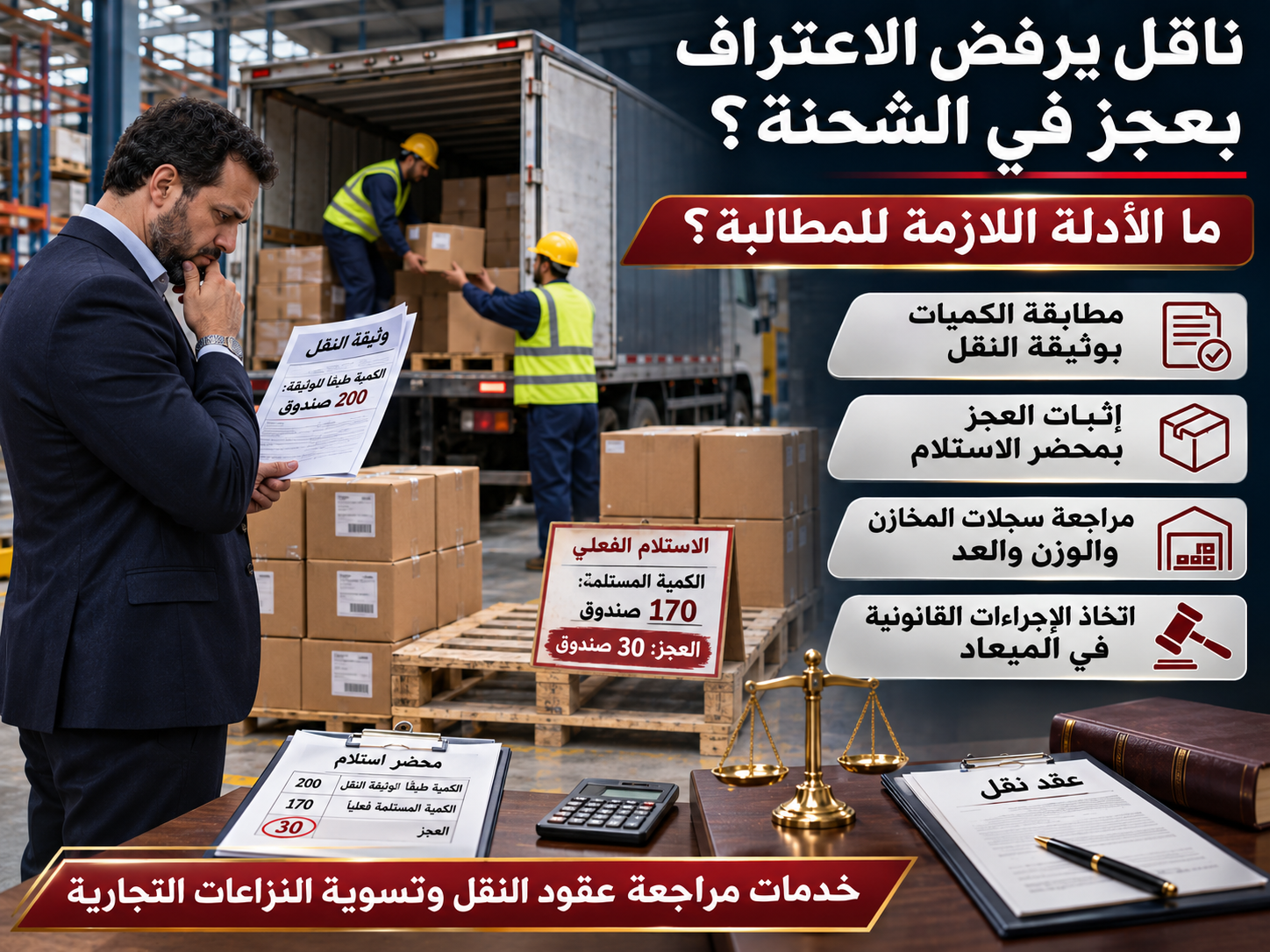
Upon delivery, warehouse employees discover that only 460 units have arrived, despite transportation documents indicating that the carrier received the complete shipment.
When contacted, the transportation company may claim that the original shipment was already incomplete, that all packages were delivered intact, or that its responsibility ended when the receiving employee signed the delivery documents.
In such disputes, demonstrating a difference between the expected and delivered quantities is not always sufficient.
The business must establish when the shortage occurred, determine whether the carrier was responsible during that period, and present reliable evidence supporting its claim.
Domestic carriage of goods in Egypt is generally governed by Commercial Law No. 17 of 1999, subject to any special legislation applicable to particular transportation methods.
Under Article 240 of the Egyptian Commercial Law, a carrier is generally responsible, from the moment it receives the goods, for their total or partial loss, damage, and delay in delivery.
Accordingly, partial shipment loss occurring during the carrier's period of responsibility may provide grounds for compensation, even where the transportation company refuses to acknowledge the shortage.
1. What Is the Difference Between a Shipment Shortage and Partial Loss of Goods?#
A shipment shortage occurs when the quantity delivered is lower than the quantity that should have been received.
Such shortages may involve missing packages, absent items inside containers, or differences between recorded and actual shipment weights.
However, not every reduction in weight or quantity automatically establishes carrier liability.
Article 242 of the Egyptian Commercial Law addresses ordinary losses resulting from the inherent nature of transported goods.
Under this provision, a carrier is generally not responsible for normal shrinkage attributable to the nature of the goods unless the claimant establishes that the shortage resulted from another cause.
The law also addresses how permissible shortages may be calculated where shipments consist of separate packages or groups with recorded weights.
For example, a minor weight reduction in goods naturally subject to evaporation may require a different legal assessment from the disappearance of an entire box containing spare parts or electronic devices.
Determining the nature of the shipment, the type of shortage, and its likely cause is therefore essential before pursuing a compensation claim.
2. What Evidence Is Required to Prove a Shipment Shortage?#
The strength of a compensation claim largely depends on the company's ability to present consistent documentation establishing the quantity received by the carrier, the quantity ultimately delivered, and the resulting shortage.
Transportation Documents and Consignment Notes
The consignment note or transportation document is among the most important records in a shipment shortage dispute.
Ideally, it should identify the sender, recipient, and carrier, together with a description of the goods, number of packages, shipment weight, collection date, and delivery destination.
Article 226 of the Egyptian Commercial Law provides that a carrier accepting goods without reservations is generally presumed to have received them in good condition and in accordance with the information recorded in the transportation document, unless the carrier proves otherwise.
Consequently, a transportation document specifying the complete shipment quantity may help challenge a carrier's later allegation that the goods were already missing when collected.
Delivery Reports and Shortage Records
Receiving employees should record any discrepancy between the goods delivered and the information contained in the transportation documents.
A detailed delivery report should identify the expected quantity, actual quantity received, missing units, condition of the packages and seals, and the date and time of delivery.
Companies should avoid signing an unconditional acknowledgment of complete delivery before verifying the quantities received.
Warehouse Records and Inventory Release Documents
Warehouse documentation may help establish that the sender prepared and released a particular quantity of goods for transportation.
Relevant records include inventory release forms, packing lists, stock movement reports, warehouse reconciliation records, and vehicle loading registers.
These documents become particularly valuable when they correspond with the consignment note and delivery records.
Weighing and Counting Records
For shipments measured by weight or individual units, supporting evidence may include weighbridge certificates, loading and unloading weight records, counting reports, and barcode scanning logs.
However, a weight discrepancy alone may not establish the cause of the shortage, particularly where weighing conditions or equipment differ.
Photographs and Surveillance Recordings
Warehouse surveillance footage, loading-area recordings, and photographs may help establish the number of packages loaded and unloaded.
Images showing vehicle seals, container locks, and packaging conditions may also help determine whether there are indications of unauthorized access during transportation.
Nevertheless, photographic or video evidence should be assessed alongside the relevant documents and circumstances rather than treated as conclusive proof by itself.
3. What Happens if an Employee Signs the Delivery Report Without Reservations?#
One of the most common difficulties arises when a warehouse employee signs a delivery acknowledgment without recording any shortage, only for missing goods to be discovered during subsequent unpacking or inventory reconciliation.
The carrier may rely on the signed document as evidence that the shipment was delivered without objection.
However, Article 251 of the Egyptian Commercial Law establishes specific rules regarding goods received without reservations.
Under this provision, the right to pursue a carrier for damage or partial loss may be forfeited unless the recipient formally establishes the condition of the goods and initiates legal proceedings within 90 days from delivery, subject to the statutory conditions and exceptions.
The law also provides exceptions involving fraud, gross negligence, or deliberate concealment of partial loss or damage.
It specifies formal methods for establishing the condition of the goods, including inspection by a competent administrative official or an expert appointed by the relevant judge.
Therefore, discovering a shortage after signing a delivery acknowledgment requires prompt legal action.
Businesses should not rely exclusively on informal complaints or ordinary internal inventory reports where formal evidence-preservation procedures may be legally required.
4. How Can You Prove the Shortage Occurred During Transportation Rather Than in the Warehouse?#
A transportation company may argue that the shipment was incomplete before loading or that the goods disappeared after unloading.
To address such allegations, the claimant should reconstruct the shipment's movement from warehouse release to final delivery.
The following evidence may help establish a reliable timeline:
Transportation Stage | Required Evidence | Purpose |
|---|---|---|
Shipment preparation | Packing lists and inventory release records | Establish the original quantity |
Handover to carrier | Consignment note and loading report | Prove what the carrier received |
Transportation period | Journey logs, seals, and monitoring records | Track shipment conditions |
Final delivery | Delivery report and inventory inspection | Establish the missing quantity |
Any inconsistencies between these records should be investigated carefully.
For example, if a carrier accepted 100 packages without reservations and only 95 were delivered, the discrepancy may provide significant evidence when evaluating responsibility.
However, the final legal assessment must consider the applicable rules, transportation conditions, and any evidence concerning the circumstances of collection and delivery.
5. Is the Carrier Responsible if It Claims Theft or an Error by the Sender?#
Transportation companies sometimes argue that missing goods were stolen during transit or that the sender made an error when preparing or loading the shipment.
These allegations do not automatically release the carrier from responsibility.
Under Article 244 of the Egyptian Commercial Law, a carrier may seek to exclude liability by establishing force majeure, an inherent defect in the transported goods, or fault attributable to the sender or recipient.
Where the carrier establishes one of these grounds, the claimant may still present evidence that the loss was not caused by the alleged circumstance.
Therefore, simply stating that goods were stolen does not necessarily establish force majeure.
The circumstances of the theft, precautions adopted by the carrier, and whether the event could reasonably have been anticipated or prevented may all be relevant.
Likewise, where the sender was responsible for loading the shipment, the applicable contractual provisions should be examined.
Where the transportation company handled collection, loading, carriage, and unloading, those responsibilities may influence the legal assessment.
6. What if Several Carriers Were Involved in Transporting the Shipment?#
Some shipments pass through several transportation stages handled by different carriers, particularly where goods move between warehouses, logistics centers, and regional distribution facilities.
In these cases, identifying the precise stage at which the shortage occurred may become difficult.
Article 252 of the Egyptian Commercial Law regulates the liability of successive carriers participating in the performance of a single transportation contract.
Subject to the statutory conditions, successive carriers may be jointly liable toward the sender or recipient.
The provision also addresses the right of a carrier that has paid compensation to seek recovery from other participating carriers.
However, it is essential to distinguish between one transportation contract performed by successive carriers and several independent transportation contracts.
The legal structure of the transaction may materially affect which parties can be held responsible.
7. How Is Compensation for Missing Goods Calculated?#
Compensation generally depends on the value of the missing goods, the nature of the shipment, the information recorded in the transportation documents, and any valid contractual limitations.
Article 247 of the Egyptian Commercial Law regulates the assessment of compensation for loss or damage.
Where the value of the goods is not stated in the transportation document, compensation is generally assessed by reference to their actual value at the place and time of arrival, subject to applicable statutory provisions or valid agreements.
Where a value is declared, the carrier may challenge it by presenting evidence of the goods' actual value.
Illustrative Compensation Calculation
Suppose a shipment contains 500 units, but only 460 units are delivered.
Missing units
40
Recorded value per unit
EGP 2,000
Initial calculated value of the shortage
EGP 80,000
Hypothetical illustration only, not a final legal assessment of recoverable compensation.
The legally recoverable amount may differ depending on the valuation rules, contractual terms, applicable liability limitations, and evidence establishing responsibility.
Claims involving lost sales, business interruption, or additional operational expenses require separate analysis of recoverability, causation, and supporting documentation.
8. What Legal Steps Should You Take if the Carrier Refuses to Acknowledge the Shortage?#
Where the carrier denies the missing quantity or refuses compensation, the business should adopt a structured approach to preserving its legal position.
Step 1: Record the Shortage and Preserve the Evidence
Prepare a detailed report identifying the missing quantities and retain relevant packaging, seals, delivery documents, and other supporting material.
Consider whether formal legal procedures are required to establish the condition of the shipment.
Step 2: Collect Transportation and Warehouse Records
Gather the transportation contract, consignment note, inventory release documents, packing lists, invoices, delivery reports, and relevant technical or surveillance evidence.
Review these documents for consistency.
Step 3: Assess Carrier Liability
Examine the carrier's contractual and statutory obligations, including any reservations recorded upon collection, loading responsibilities, custody arrangements, and delivery procedures.
Step 4: Submit a Formal Legal Demand
Prepare a documented compensation claim identifying the shipment, shortage, available evidence, legal grounds for liability, and compensation requested.
Step 5: Explore Negotiation or Settlement
Negotiation may be appropriate where the documents clearly establish the shortage and both parties are willing to resolve the dispute commercially.
Step 6: Consider Litigation or Arbitration
If settlement efforts are unsuccessful, the company may consider bringing a compensation claim before the competent court.
Arbitration may be available where a valid arbitration agreement applies.
Throughout these steps, particular attention should be paid to statutory deadlines, especially where goods were accepted without reservations.
9. What Legal Deadlines Should Businesses Consider?#
Delays in taking legal action may weaken a claim or result in the loss of the right to pursue compensation.
Two legal timeframes are particularly important.
The 90-Day Rule
Article 251 of the Egyptian Commercial Law addresses cases involving goods received without reservations.
Where the provision applies, the recipient must formally establish the condition of the goods and initiate proceedings within 90 days from delivery, subject to the relevant statutory exceptions.
The One-Year Limitation Period
Article 254 generally provides a one-year limitation period for legal actions arising from contracts for the carriage of goods.
The starting date depends on the circumstances specified in the legislation.
Exceptions exist in cases involving fraud or gross negligence, while the law also establishes particular rules concerning claims between successive carriers.
Businesses should distinguish between these separate deadlines and should not assume that submitting a complaint or continuing negotiations automatically suspends them.
Obtaining legal advice immediately after discovering a shortage can help prevent avoidable procedural difficulties.
10. How Can Businesses Prevent Future Shipment Shortage Disputes?#
Factories, importers, and distribution companies can reduce the likelihood of disputes by establishing clear transportation and delivery procedures.
Useful preventive measures include accurately recording shipment quantities, weights, and package numbers; using standardized loading and delivery reports; documenting vehicle and container seals; maintaining electronic inventory and barcode records; and clearly allocating responsibility for loading, custody, and unloading.
Transportation agreements should also address liability, compensation, insurance, and procedures for reporting missing goods.
A reliable documentation process can help businesses identify discrepancies promptly and reduce disagreements over the quantities received by the carrier.
How Can Legal Consultation Help Resolve Shipment Shortage Disputes?#
When a transportation company refuses to acknowledge missing goods, a legal review can help determine the strength of the compensation claim and identify appropriate next steps.
Legal services relating to transportation agreements and commercial dispute resolution may include examining consignment notes, delivery reports, warehouse records, and contractual obligations.
A legal adviser can also assess the available evidence, identify potentially responsible parties, evaluate compensation claims, and determine the applicable procedures and deadlines.
Depending on the circumstances, professional assistance may support negotiation, settlement, litigation, or arbitration.
Carefully drafted transportation agreements can also help businesses allocate responsibilities more clearly and reduce future disputes.
Conclusion#
A carrier's refusal to acknowledge a shipment shortage does not automatically eliminate the sender's or recipient's right to seek compensation.
However, a successful claim depends on reliable documentation, proof of the quantities received and delivered, an assessment of carrier responsibility, and compliance with applicable legal deadlines.
Businesses should act promptly to preserve evidence, investigate discrepancies, and evaluate their contractual and statutory rights.
If your company has discovered missing goods and the carrier refuses to acknowledge the shortage, request a legal review of your shipping documents, delivery reports, and warehouse records to assess liability, examine the available evidence, and identify appropriate options for compensation or dispute resolution.