When a Marketing Agency Uses Your Company's Designs Without Authorization#
Businesses frequently work with marketing and advertising agencies to develop creative materials that strengthen their brand identity and support commercial campaigns.
These materials may include advertising graphics, logos, promotional videos, digital illustrations, social media content, and other original creative assets.
However, disputes can arise when a marketing agency uses these materials beyond the purposes originally agreed upon.
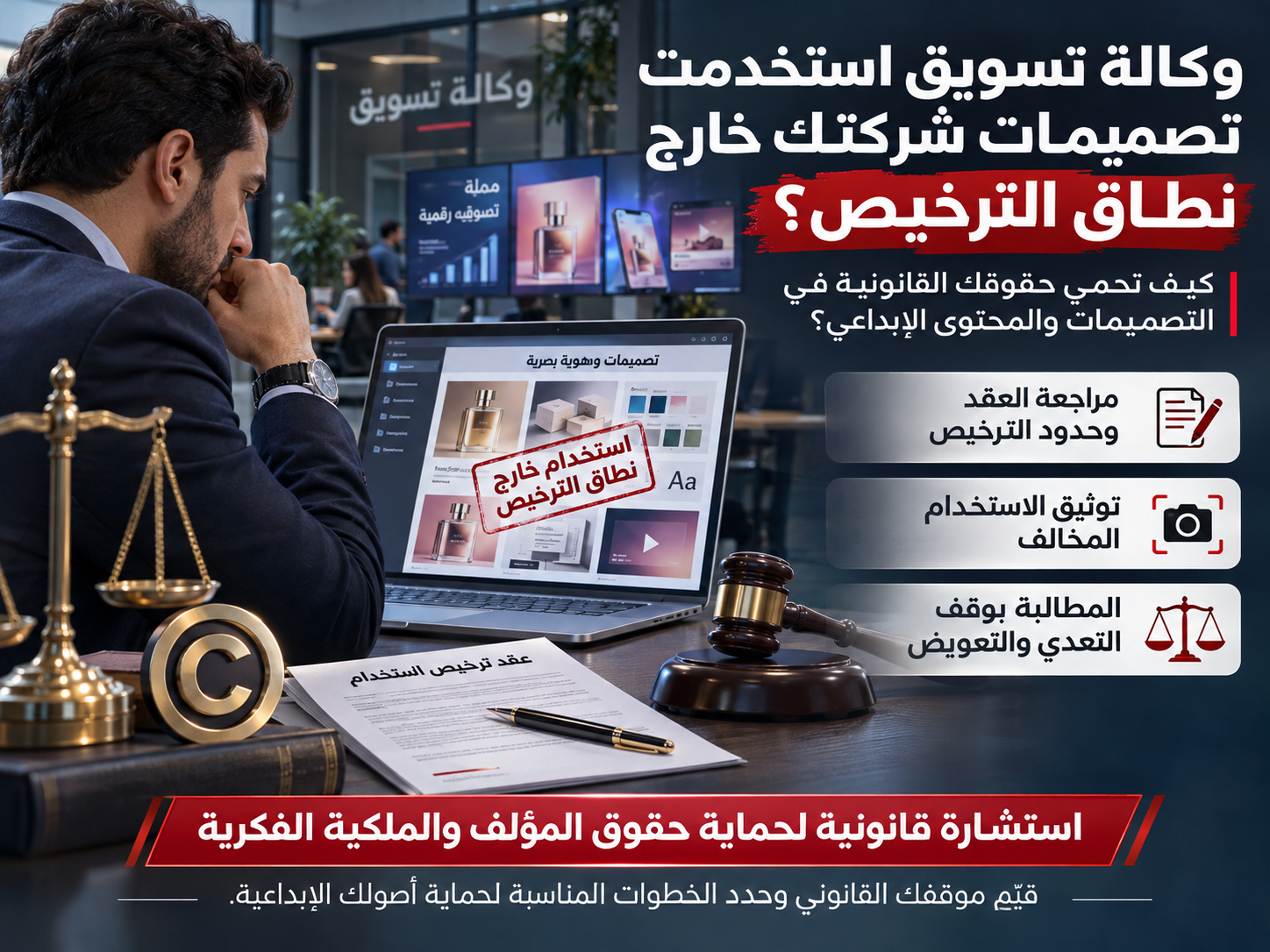
For example, a company may discover that its marketing agency has incorporated commissioned designs into another client's advertising campaign, published creative content on unauthorized platforms, or modified materials for additional commercial purposes.
Such situations raise an important legal question: Does paying for a design automatically give a company full ownership of its intellectual property rights?
Under Egyptian law, the answer depends on the nature of the creative work, the contractual arrangements, the ownership of the relevant rights, and whether those rights were legally transferred or licensed.
Understanding these distinctions is essential before pursuing legal action.
1. Who Owns Designs Created by a Marketing Agency?#
Copyright ownership is one of the most common sources of disagreement between businesses and marketing agencies.
Under Egyptian Intellectual Property Protection Law No. 82 of 2002, original creative works may qualify for copyright protection when the applicable legal requirements are satisfied.
The law distinguishes between the author's moral rights and the economic rights associated with exploiting a protected work.
Article 149 regulates the transfer of economic rights and requires such transfers to be documented in writing, clearly identifying the rights transferred and the extent, purpose, duration, and territory of their exploitation.
Accordingly, ownership disputes may involve three different situations.
Designs created under an agreement transferring economic rights
If a contract expressly and validly transfers specified economic rights to the client, the company may exercise those rights within the agreed contractual scope.
However, the transfer of economic rights does not automatically eliminate the author's moral rights.
Designs provided under a limited license
In some cases, an agency or designer retains the relevant economic rights while granting the client permission to use the designs for specific campaigns, platforms, territories, or periods.
The company must then respect the boundaries of that license.
Designs created without clear intellectual property provisions
When an agreement does not clearly address copyright ownership or licensing, disputes may arise regarding which rights were transferred and whether either party can reuse the materials.
Importantly, paying an invoice for creative services does not necessarily establish ownership of every economic right associated with the resulting designs.
A proper legal assessment requires examining the agreement, the creative work, and the circumstances surrounding its production.
2. When Does Using Designs Beyond a License Become a Legal Violation?#
Unauthorized use may occur when a party exploits copyrighted material beyond the permissions granted by the relevant rights holder.
Examples may include:
Reusing a client's designs in advertising campaigns for other businesses without the necessary authorization.
Publishing creative materials on platforms not covered by the original license.
Continuing to use designs after the agreed licensing period expires.
Modifying or reproducing designs for commercial purposes outside the contractual scope.
Granting third parties permission to use protected materials without having the legal authority to do so.
Article 147 of Egyptian Intellectual Property Protection Law addresses the author's exclusive economic rights, including various forms of reproduction, communication to the public, and adaptation.
Article 149 also establishes requirements governing the transfer of economic rights.
Consequently, permission to exploit one particular right should not automatically be interpreted as permission to exercise all other rights.
Nevertheless, not every instance of reuse constitutes copyright infringement.
A legal violation depends on whether the complaining party holds the relevant rights, the exact scope of authorization, the characteristics of the work, and the nature of the disputed use.
3. Can Marketing Agencies Display Client Designs in Their Portfolios?#
Marketing agencies commonly feature completed projects on their websites, social media accounts, and promotional materials to demonstrate their capabilities.
However, displaying a client's designs may create legal concerns when the relevant permissions are unclear.
Several factors should be considered.
Contractual authorization
Does the agreement explicitly permit the agency to display completed work in its portfolio or promotional materials?
Nature of the creative content
Does the design contain confidential business information, sensitive campaign materials, or proprietary branding elements?
Ownership of economic rights
Does the agency retain the relevant display rights, or have those rights been transferred or exclusively licensed to another party?
Purpose of the display
Is the agency merely presenting previously completed work, or is it using the designs to promote unrelated commercial products or services?
Trademark rights, confidentiality obligations, and third-party intellectual property rights may also affect the legal assessment.
For these reasons, businesses and agencies should clearly regulate portfolio usage in their contracts rather than relying on assumptions.
4. What Evidence Is Required to Prove Unauthorized Design Use?#
A successful legal claim generally depends on establishing the relevant rights, demonstrating the disputed use, and providing evidence that the use exceeded the permitted scope.
Businesses should consider preserving the following documents.
Marketing and design agreements
Contracts can establish the commissioned work, licensing conditions, ownership arrangements, and restrictions on commercial exploitation.
Emails and written correspondence
Communications between the parties may help demonstrate the original instructions, agreed permissions, subsequent amendments, and approvals.
Original design files
Source files, drafts, and project records may support evidence concerning the creation and development of the work.
Invoices and payment records
Financial documents can establish the commercial relationship and the services purchased, although payment alone may not prove the transfer of all intellectual property rights.
Evidence of disputed use
Relevant evidence may include advertising links, social media posts, campaign screenshots, publication dates, and records of commercial distribution.
Third-party licensing documents
Licenses for stock photographs, fonts, illustrations, music, and other incorporated materials may be necessary to establish the legal status of the complete design.
Digital evidence should be preserved carefully, particularly where online materials can be altered or deleted.
Depending on the circumstances, formal technical documentation or judicial evidence-preservation measures may be appropriate.
5. What Legal Steps Can a Business Take Against Unauthorized Design Use?#
When a company discovers that a marketing agency may have used its designs without authorization, it should assess the situation systematically before initiating legal proceedings.
Step 1: Review the Agreement and Identify the Relevant Rights
The first step is to examine the marketing agreement, design contract, and any applicable licensing documents.
The review should determine who owns the economic rights, what permissions were granted, and whether subsequent communications modified the original agreement.
Step 2: Document the Alleged Unauthorized Use
Businesses should collect and preserve the original designs alongside evidence of the disputed use.
Relevant materials should establish when and where the content appeared, how it was used, and why the company considers that use unauthorized.
Step 3: Send a Formal Legal Notice
Where the available evidence supports a potential claim, the company may consider sending a formal legal notice to the agency.
The notice may identify the disputed materials, explain the legal basis of the company's rights, describe the alleged violation, and request appropriate corrective measures.
Depending on the circumstances, these may include stopping unauthorized use, removing content, or clarifying the basis on which the agency claims authorization.
Step 4: Consider Negotiated Settlement
Not every intellectual property dispute requires immediate litigation.
In some situations, the parties may resolve their disagreement through a revised license, additional licensing fees, removal of disputed materials, or an agreement governing future use.
The suitability of settlement depends on the evidence, the nature of the alleged infringement, and the commercial interests involved.
Step 5: Pursue Judicial Remedies When Necessary
If the dispute cannot be resolved, the rights holder may consider judicial remedies available under Egyptian law.
Depending on the circumstances and statutory requirements, these may include applications for appropriate protective or precautionary measures and claims for damages.
The correct legal approach depends on the contractual relationship, the applicable rights, available evidence, and the nature of the alleged infringement.
6. Can a Company Claim Compensation for Unauthorized Use of Its Designs?#
Unauthorized commercial exploitation of protected creative materials may cause financial or reputational damage.
Potential losses may include:
Licensing revenue that could otherwise have been earned from authorized use.
Loss of commercial exclusivity associated with an advertising campaign.
Damage to the company's commercial reputation through inappropriate use of its creative materials.
Expenses incurred in addressing the consequences of the unauthorized use.
However, compensation is not automatically available merely because a disagreement exists.
A compensation claim requires an appropriate legal basis and an assessment of the relevant elements of liability, including damage and causation where applicable.
The available remedies and evidentiary requirements may also differ depending on whether the dispute primarily concerns breach of contract, infringement of intellectual property rights, or both.
Businesses should therefore avoid assuming that a specific compensation amount is guaranteed.
7. How Can Businesses and Marketing Agencies Prevent Design Ownership Disputes?#
Many disputes involving commissioned creative work result from vague contractual provisions rather than deliberate misconduct.
Clear agreements can significantly reduce these risks.
A professionally drafted marketing or design contract should address ownership and transfer of specified economic rights, licensing duration, permitted territories and platforms, rights to modify or reproduce content, agency portfolio usage, confidentiality obligations, the use of third-party creative assets, and the treatment of intellectual property rights after termination.
The agreement should also clarify how original design files will be delivered and whether subcontractors or independent designers are involved in producing the work.
These provisions help businesses protect their creative investments while allowing marketing agencies to understand their commercial rights and obligations.
8. The Role of Legal Consultation in Copyright and Design Licensing Disputes#
Protecting commissioned designs requires more than identifying who originally created them.
It involves determining the legal ownership of relevant economic rights, interpreting licensing provisions, assessing potential infringement, and selecting appropriate legal remedies.
Through professional services covering trade name protection, copyright, and related rights, legal advisors can assist businesses with reviewing marketing and design contracts, evaluating intellectual property ownership, examining evidence of unauthorized use, preparing legal notices, negotiating settlements, and pursuing litigation where appropriate.
Preventive legal advice can also help businesses and creative agencies establish clearer contractual arrangements and reduce the risk of future disputes.
Protecting Creative Assets Begins with Clear Legal Rights#
A marketing agency's use of commissioned designs outside an agreed license can create serious contractual and intellectual property disputes.
However, determining whether an infringement has occurred requires careful consideration of copyright ownership, licensing restrictions, and the evidence supporting the alleged unauthorized use.
Businesses should begin by reviewing their agreements, identifying the relevant rights, preserving evidence, and assessing the available legal options.
If a marketing agency has used your company's designs beyond the agreed scope, consulting an intellectual property lawyer can help you review the relevant documents, evaluate your legal position, and determine the appropriate steps to protect your rights.