
What Happened, and Why Has the Licensing Suspension Been Extended?#
On November 12, 2026, Egypt's Financial Regulatory Authority announced the continuation of restrictions on applications to establish and license certain financial services companies.
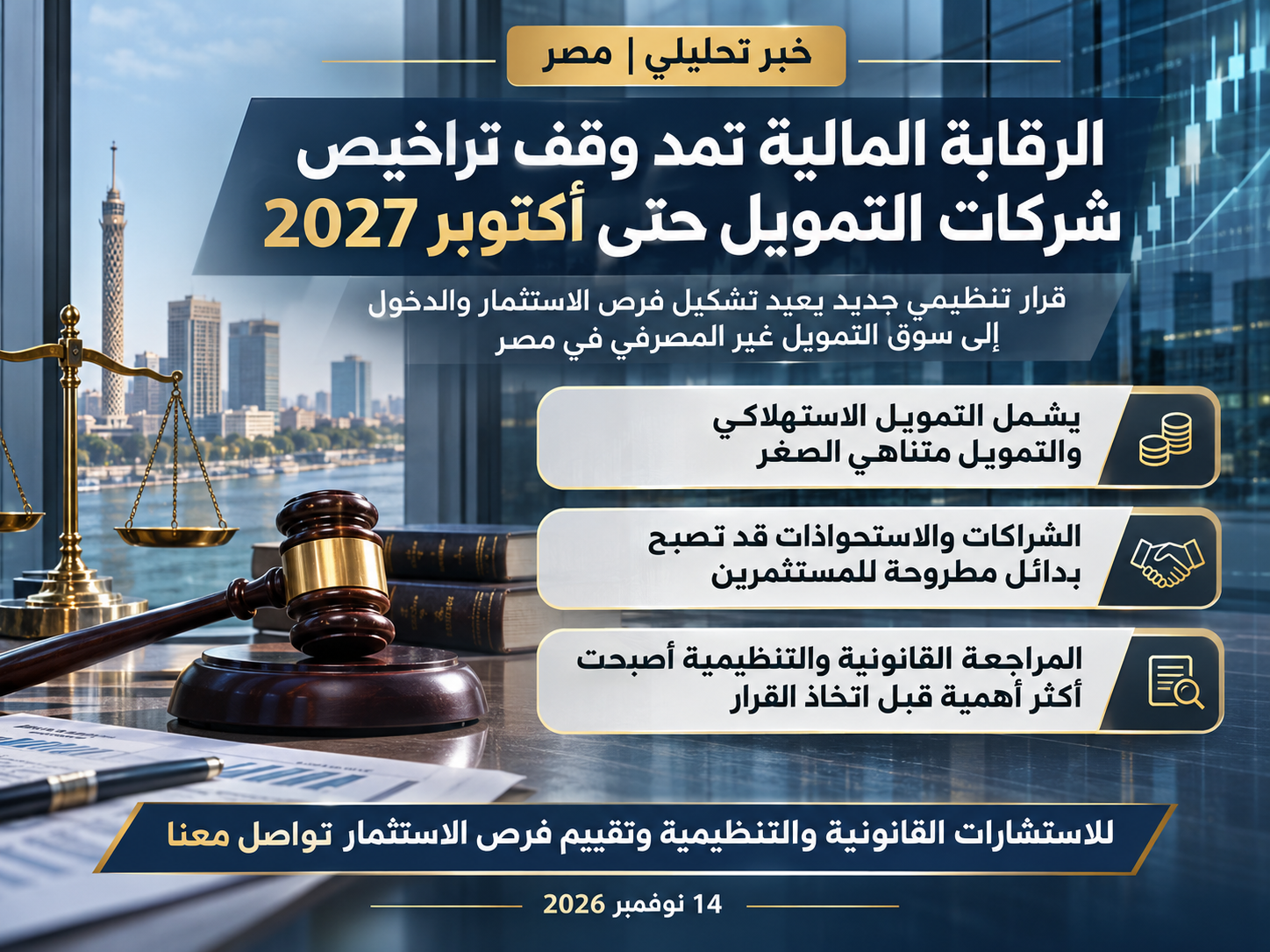
Under Decision No. 213 of 2026, the FRA extended the suspension of applications for the establishment, preliminary approval, and licensing of new companies seeking to conduct traditional consumer finance and microfinance activities.
The restrictions also cover applications submitted by associations and non-governmental organizations seeking authorization to engage in microfinance activities.
The decision follows earlier regulatory measures introduced under Decision No. 184 of 2024.
According to the FRA's official announcement, the continued suspension forms part of its efforts to maintain financial stability, consider market conditions, and support the quality of financial services provided to customers.
The extension remains effective until October 11, 2027.
Does the Decision Close Egypt's Financial Market to New Investors?#
Although the suspension restricts applications for establishing and licensing new companies in the specified activities, it does not necessarily prohibit every form of investment in the sector.
Investors may consider alternative market entry strategies, including partnerships with existing financial institutions or potential acquisitions of equity stakes in licensed companies.
However, these alternatives must be evaluated carefully.
Acquiring an interest in an existing financial company does not automatically eliminate regulatory requirements or guarantee approval from the relevant authorities.
Depending on the transaction structure, investors may still need to comply with applicable ownership restrictions, disclosure obligations, and regulatory approval procedures.
Consequently, legal due diligence and regulatory assessment become increasingly important before pursuing any investment transaction.
What About Financial Technology Companies?#
The regulatory restrictions also extend to certain financial technology activities.
According to the FRA's announcement, the suspension of applications for establishing and licensing consumer finance companies operating through financial technology remains in effect under Decision No. 43 of 2026 until February 25, 2027, with the possibility of further extension.
This development highlights the importance of regulatory classification for financial technology businesses.
Entrepreneurs developing digital lending platforms or technology-driven financial services should carefully examine whether their proposed business activities require authorization under Egypt's financial regulatory framework.
A technology-based operating model does not necessarily exempt a company from financial licensing requirements.
How Could the Decision Affect Investors and Existing Financial Companies?#
The continued licensing suspension could influence Egypt's non-banking financial market in several ways.
1. Increased Interest in Existing Licensed Companies#
Investors seeking access to regulated financial activities may become more interested in acquiring stakes in companies that already hold the necessary licenses.
This could encourage discussions involving strategic partnerships, equity investments, and corporate acquisitions.
However, increased interest does not necessarily mean that company valuations will rise. Transaction values will continue to depend on profitability, financial performance, regulatory compliance, portfolio quality, and market conditions.
2. Delays in New Investment Projects#
Companies that previously intended to establish new consumer finance or microfinance businesses may need to postpone their plans or reconsider their proposed investment structures.
Such delays could create additional financial consequences, including higher preliminary operating expenses, extended investment periods, and potential opportunity costs.
Investors may therefore need to update their feasibility studies and financial projections.
3. Greater Importance of Regulatory Due Diligence#
As acquisition and partnership opportunities become potential alternatives, comprehensive legal and regulatory due diligence becomes essential.
Investors should assess the validity and scope of existing licenses, outstanding regulatory obligations, compliance history, ownership structures, and potential liabilities before completing transactions.
Failure to identify regulatory risks at an early stage could result in unexpected costs, approval delays, or difficulties implementing investment plans.
Could the Suspension Reshape Competition in Egypt's Financial Sector?#
The continuation of licensing restrictions could influence competitive dynamics within the affected market segments.
Existing licensed companies may have additional opportunities to strengthen their operations, improve service quality, and develop their customer portfolios while applications from new market entrants remain suspended.
At the same time, investors seeking to enter the market may increasingly explore partnerships or acquisitions involving established financial institutions.
Nevertheless, the suspension does not guarantee improved profitability for existing companies.
Financial performance will continue to depend on consumer demand, funding costs, credit risk, operational efficiency, and broader economic conditions.
The long-term impact will also depend on future regulatory decisions and developments in Egypt's financial services market.
What Should Investors Consider Before Entering the Market?#
Investors evaluating opportunities in Egypt's financial sector should prioritize a comprehensive assessment of both regulatory and commercial factors.
An appropriate evaluation should include the applicable licensing framework, the proposed business model, the legal status of potential acquisition targets, and the approvals required for specific transactions.
Financial feasibility studies should also consider the consequences of delayed market entry, compliance expenses, and potential changes in regulatory requirements.
Importantly, any acquisition or partnership structure should be reviewed to ensure that it complies with applicable Egyptian laws and FRA regulations.
Professional legal and financial advice can help investors identify viable strategies while minimizing exposure to regulatory and transactional risks.
Conclusion: A Regulatory Decision With Broader Investment Implications#
Egypt's decision to extend the suspension of certain finance company licensing applications until 2027 represents more than an administrative restriction.
It introduces significant considerations for investors, financial institutions, and entrepreneurs planning to operate in the country's non-banking financial sector.
While the suspension limits the establishment of new companies in the specified activities, it may also encourage investors to examine alternative market entry structures, including partnerships and acquisitions.
As Egypt's financial regulatory environment continues to evolve, understanding licensing requirements, conducting legal due diligence, and evaluating investment risks will remain essential to informed business decisions.
Planning to invest in Egypt's financial services sector or acquire an existing financial company?
Professional legal and regulatory advisory services can help assess licensing requirements, evaluate transaction risks, review corporate structures, and identify legally compliant investment opportunities.


