
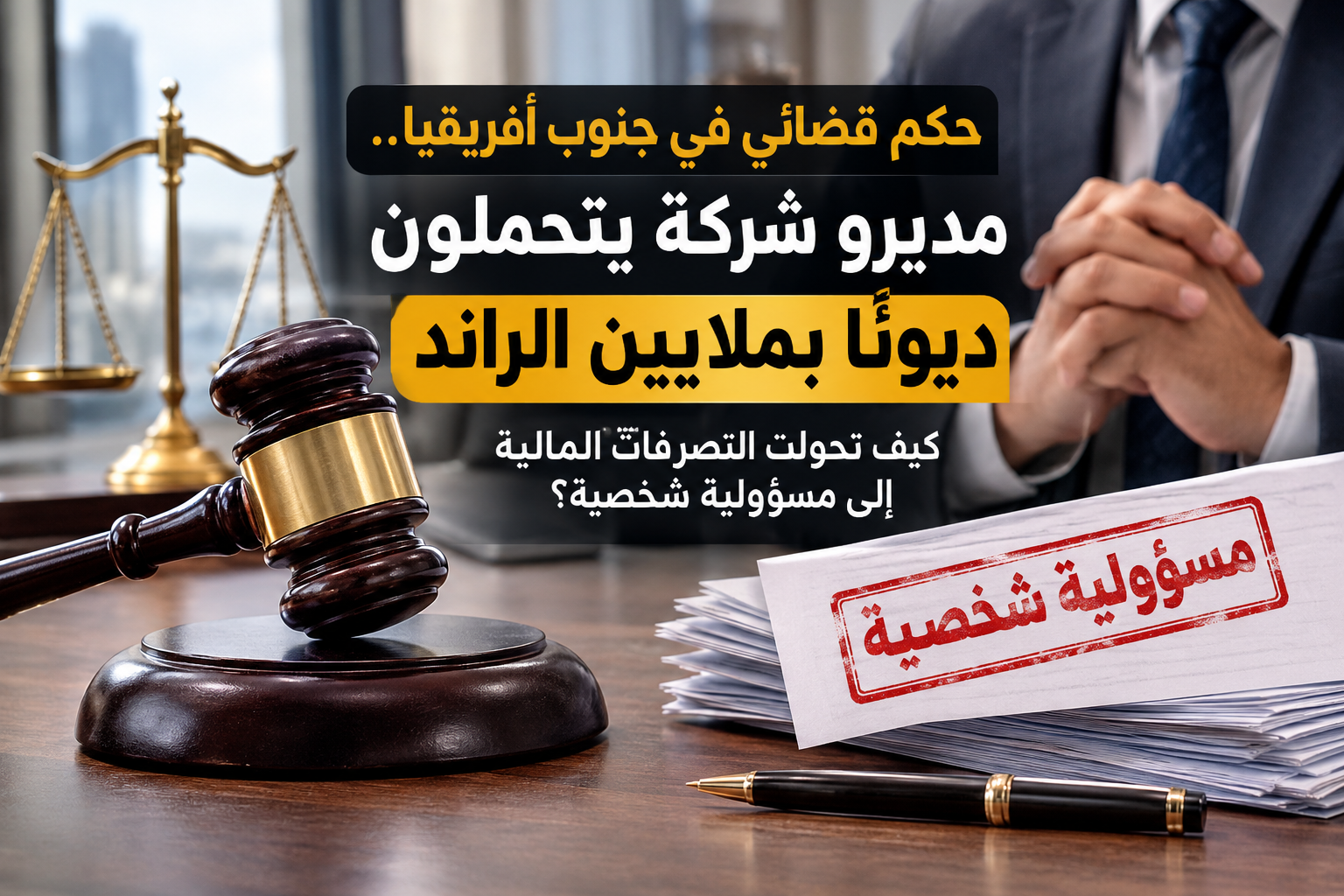
A company may experience financial difficulties because of declining sales, rising liabilities or the loss of a major supplier. However, the legal risks become significantly greater when management continues taking on new obligations despite knowing that the company may be unable to meet its financial commitments, or when company funds are used for transactions that lack proper authorization and documentation.
This issue was central to an important South African court case in which two company directors were held personally liable for losses exceeding ZAR 2.83 million, even though the underlying commercial debts belonged to the company they managed.
How Did the Dispute Begin? A Distribution Company Facing Mounting Debts#
The dispute arose from a commercial relationship between Yokogawa South Africa, a company involved in the supply of industrial control equipment, and 3E Control and Instrumentation, a distribution company that purchased products from the supplier.
Under their commercial arrangement, the distributor purchased products on credit and resold them to its customers, including a major mining company. The arrangement required certain customer payments to be transferred to the supplier in settlement of the products supplied.
However, the commercial relationship deteriorated as unpaid invoices accumulated.
In November 2019, the parties entered into a repayment arrangement acknowledging outstanding liabilities exceeding ZAR 6.52 million. The arrangement also included provisions requiring certain customer payments to be transferred to the supplier within 24 hours of receipt.
Despite this arrangement, the distributor continued placing additional orders on credit without settling its existing outstanding invoices.
Between December 2019 and April 2021, the company placed 59 additional purchase orders with a total value of ZAR 2,832,601.73. These amounts remained unpaid.
Where Did the Financial Irregularities Appear?#
The dispute was not limited to unpaid commercial invoices. Examination of the company's bank transactions revealed several financial activities that raised questions about how company funds were being managed.
1. Retention of Customer Payments
The evidence showed that certain customers had paid for products they received, but the distributor failed to transfer the corresponding amounts to the supplier.
The November 2019 repayment arrangement had already acknowledged the existence of customer collections that had not been transferred, including approximately ZAR 2.2 million within one component of the outstanding liabilities.
2. Transfers to a Company Director
The court examined payments made from the company's bank account to its first director under descriptions relating to loans and repayment of amounts allegedly advanced to the company.
However, the director failed to provide written loan agreements or properly documented board resolutions demonstrating approval of the transactions in accordance with the applicable legal requirements.
The court considered these transactions particularly significant in light of the company's continuing failure to settle its supplier obligations.
3. An Unexplained ZAR 450,000 Transfer
The court also considered a transfer of ZAR 450,000 made from the company's bank account on June 24, 2021, approximately two months before the company entered liquidation.
The director was unable to provide a satisfactory explanation or sufficient supporting documentation for the transaction, further raising concerns about the company's financial management during its period of financial distress.
Why Did the Court Hold the Directors Personally Liable?#
The court relied on the South African Companies Act 71 of 2008, particularly Sections 22, 214 and 218.
These provisions address reckless trading, knowing participation in certain unlawful corporate conduct, and civil liability for losses resulting from violations of the legislation.
The court found that the company's continued acquisition of goods on credit, despite management's knowledge of its inability to meet its financial obligations, could not be treated as an ordinary commercial failure.
The retention of supplier-related customer payments and inadequately documented transactions involving directors further supported the court's assessment.
Importantly, the court distinguished between the conduct and legal responsibility of the two directors.
The first director: The court found that he had knowingly participated in conduct calculated to prejudice creditors and had been involved in the company's reckless trading. His liability was established under Section 218(2).
The second director: The court did not find that she had personally participated in all the specific transactions identified as improper. However, it found that she had knowingly permitted the company to continue trading recklessly in her capacity as a director. Her liability was established under Sections 22 and 218(2).
This distinction is particularly important: the court did not treat a person's position as a director as sufficient, by itself, to establish personal liability. It examined the individual's knowledge, conduct and involvement in the company's affairs.
How Much Compensation Were the Directors Ordered to Pay?#
The court ordered the two directors to pay ZAR 2,832,601.73 jointly and severally, together with interest calculated in accordance with the applicable contractual rate specified in the judgment, as well as legal costs.
The ruling allowed the creditor to pursue the directors personally within the scope of the liability established by the court, rather than being restricted to a claim against the company, which had entered liquidation.
This aspect is particularly significant for commercial suppliers because it demonstrates that dealing with a limited liability company does not necessarily prevent creditors from pursuing directors personally when the legal requirements for such liability are established.
Which Financial Documents Can Help Protect a Company and Its Directors?#
The case demonstrates that financial documentation is not merely an accounting requirement. It can become a decisive factor in determining legal responsibility.
Companies should maintain appropriate records and controls, including:
Board resolutions: Documenting approval of financial transactions, loans and significant transfers.
Director loan agreements: Establishing the legal basis and repayment terms of transactions between the company and its directors.
Bank statements: Providing a clear record of the movement of corporate funds.
Customer collection records: Tracking payments received and amounts payable to suppliers.
Cash-flow reports: Monitoring the company's ability to meet existing and future obligations.
Board meeting minutes: Recording management discussions and decisions concerning financial difficulties.
Director current accounts: Maintaining regular reconciliations of balances involving directors and shareholders.
Accounting records: Ensuring that financial information is complete and available to auditors and liquidators.
Companies should also establish internal approval procedures to prevent personal transactions from being conducted through corporate bank accounts without an appropriate legal basis.
What Does the Judgment Mean for Companies, Suppliers and Business Owners?#
The ruling carries several practical lessons.
For directors and business partners: Describing a transfer as a loan or repayment of an amount previously advanced to the company is not necessarily sufficient. Transactions must be properly documented and approved in accordance with applicable legal requirements.
For suppliers: Monitoring customers' financial condition becomes increasingly important when payment delays are accompanied by continued credit purchases and growing outstanding balances.
For shareholders: Related-party transactions should be reviewed carefully to ensure that management does not prioritize personal interests over the company's interests and its obligations to creditors.
For family-owned businesses: Separating personal finances from company accounts is particularly important. Clear rules governing withdrawals, transfers and borrowing can prevent personal relationships from undermining financial controls.
Can This Judgment Be Applied to Companies in Egypt?#
It is important to recognize that this judgment was issued by a South African court and was based on South African company legislation. Its provisions are therefore not directly binding on Egyptian courts.
Nevertheless, the case raises an important legal and commercial question for Egyptian companies: under what circumstances can a director or business partner become personally liable for dealing improperly with company funds or allowing a company to continue operating in circumstances that expose creditors to significant financial risks?
Assessing such a situation under Egyptian law requires examining the company's legal structure, the relevant provisions of the Egyptian Companies Law, the Civil Code and applicable criminal legislation.
The company's articles of association, management authority, shareholder resolutions, accounting records and the nature of the disputed transactions must also be reviewed before determining the potential legal consequences.


