
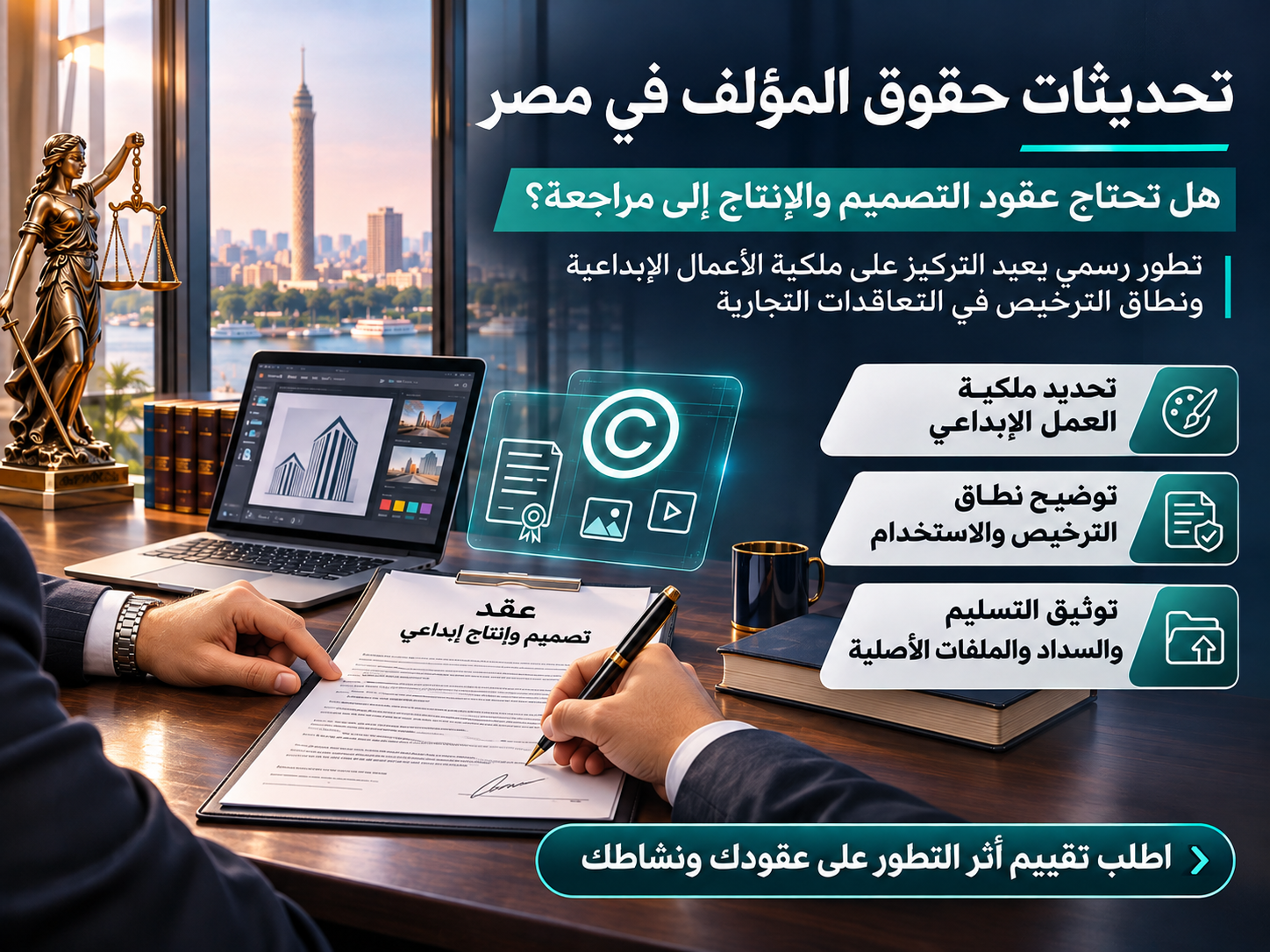
A New Development Brings Creative Rights into Focus#
As businesses increasingly invest in digital content, advertising campaigns, visual identities, and creative production, questions surrounding the ownership of commissioned works are becoming more significant.
On November 16, 2026, Egyptian Prime Minister Mostafa Madbouly reaffirmed the government's commitment to updating the country's intellectual property legislative framework to address emerging technological challenges.
The announcement came during the opening of the international conference Copyright: Emerging Issues, organized in cooperation with the World Intellectual Property Organization (WIPO) and the Egyptian Intellectual Property Authority.
Held from November 16 to 18, 2026, the conference addresses challenges facing copyright protection, particularly those associated with artificial intelligence, digital innovation, and the commercial use of creative works.
Although the announcement does not constitute an enacted legislative amendment, it signals continued government attention to the legal frameworks governing intellectual property.
Does Paying for a Design Automatically Transfer Ownership?#
One of the most common legal disputes between businesses and creative professionals concerns the distinction between paying for a commissioned work and acquiring the rights to commercially exploit it.
For example, a company may commission a designer to develop a brand identity, promotional campaign, or digital content and pay the agreed fee.
However, a dispute may subsequently arise over whether the company has the right to modify the work, reproduce it, license it to third parties, or use it across additional commercial platforms.
Under Egyptian Intellectual Property Protection Law No. 82 of 2002, copyright includes moral rights and economic rights, which are subject to different legal protections.
Article 149 establishes requirements governing the transfer of an author's economic rights, including written documentation and the specific identification of the rights being transferred.
Consequently, payment for a creative work should not automatically be interpreted as transferring every economic right associated with that work.
The actual legal position depends on the contractual provisions, the nature of the commissioned work, and the applicable statutory rules.
How Could These Developments Affect Design, Advertising, and Production Contracts?#
While the government's announcement does not independently introduce new contractual obligations, it provides an important opportunity for businesses and creative professionals to review existing agreements.
Several contractual matters deserve particular attention:
Ownership of Economic Rights: Clearly identify which party owns or receives the economic rights associated with a commissioned design or creative production.
Licensing Scope: Specify whether the agreement transfers rights or grants a limited commercial license.
Duration and Territory: Define the period and geographic locations in which the work may be commercially exploited.
Modification and Reproduction: Clarify the permitted uses, adaptations, reproductions, and sublicensing arrangements, subject to applicable moral rights.
Third-Party Materials: Document the rights associated with photographs, illustrations, music, and other creative elements incorporated into the final work.
AI-Generated Content: Establish contractual responsibilities concerning materials produced or modified using artificial intelligence tools.
These considerations become particularly important when businesses use the same creative materials across multiple advertising channels, products, or international markets.
Artificial Intelligence Introduces New Copyright Challenges#
Copyright disputes are no longer limited to unauthorized copying or the commercial use of creative works without permission.
The rapid expansion of artificial intelligence has introduced additional legal questions concerning the sources of training materials, the rights of original creators, and the commercial exploitation of AI-generated outputs.
These challenges are particularly relevant to marketing agencies, digital production companies, software developers, and content creators.
The Egyptian government's emphasis on updating intellectual property legislation reflects the growing need to balance the protection of creative rights with technological innovation.
Nevertheless, the recent announcement should not be interpreted as establishing definitive legal rules concerning the ownership or copyright protection of all AI-generated works.
Further legislative and regulatory developments will need to be assessed as they are formally introduced.
What Should Businesses and Creative Professionals Document?#
Effective copyright protection begins with clear contractual documentation.
Companies, marketing agencies, designers, and producers should retain records that help establish the nature of their commercial relationships and the scope of the rights involved.
Relevant documentation may include signed agreements, contractual amendments, original design files, payment records, delivery confirmations, licensing documents, and correspondence specifying permitted uses.
Particular attention should be given to contracts containing broad expressions such as "all rights belong to the company" without clearly defining the economic rights involved.
Properly structured agreements can help reduce uncertainty, prevent disputes, and establish a stronger evidentiary basis when disagreements arise.
Conclusion: Protecting Creative Assets Begins with Clear Contracts#
Egypt's continued efforts to modernize intellectual property legislation highlight the growing commercial importance of copyright protection in the digital economy.
For companies investing in branding, advertising, content development, and creative production, the central challenge is not simply obtaining creative work but ensuring that its ownership and permitted commercial uses are properly documented.
Although no new copyright amendment has been established by the November 16 announcement itself, businesses and creative professionals can use this development as an opportunity to review their existing contractual arrangements.
Businesses, marketing agencies, designers, and content creators may benefit from a legal assessment of their design and production agreements to determine ownership rights, review licensing arrangements, and evaluate the potential impact of future regulatory developments on their operations.


